
Offset or digital printing: the first production decision
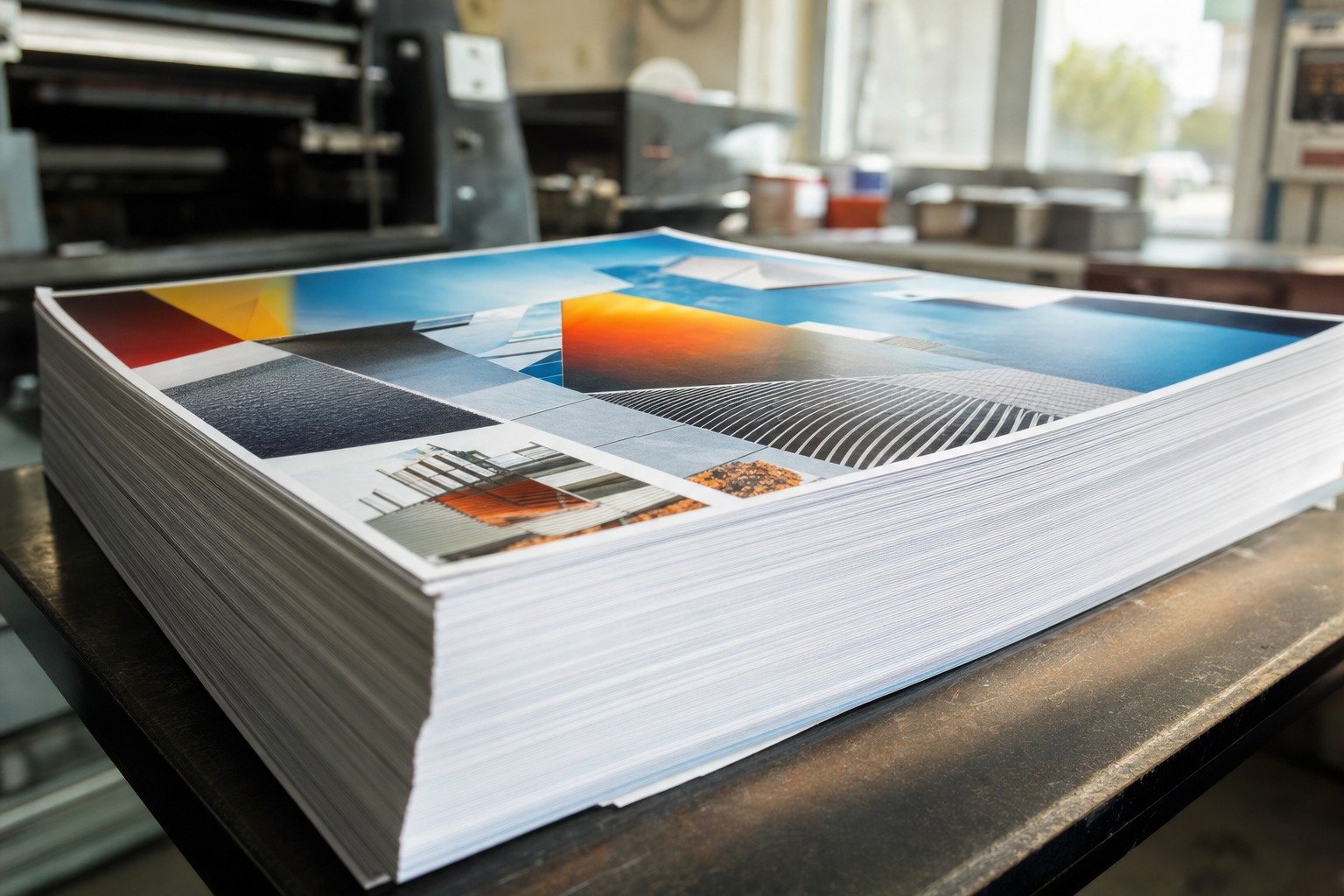
Offset printing is usually the stronger commercial printing choice for annual reports and corporate publications with substantial quantities, exacting colour requirements, or premium finishing. Digital printing is better suited to short runs, late-stage versioning, and publications requiring variable content.
This annual reports and corporate publications offset printing guide for Montreal companies compares the two processes based on the decisions that affect budgets, approvals, print quality, and distribution. The right printing company should evaluate the complete production program rather than recommend a process based only on quantity.
| Dimension | Offset printing | Digital printing |
|---|---|---|
| Cost structure | Higher setup cost, with a lower unit cost as quantity rises | Lower setup cost, but unit costs may remain higher at volume |
| Best use case | Long runs, stable content, demanding colour, special inks | Short runs, multiple versions, variable data, urgent updates |
| Colour control | Strong process control and spot-colour options | Consistent output without plates, although colour gamut and matching vary by device |
| Paper selection | Broad paper stock and sheet-size options | Paper choices depend on the press and format |
| Finishing | Well suited to foil, embossing, die-cutting and complex binding | Many finishing options are available, subject to sheet and toner limitations |
| Personalization | Normally limited unless combined with a digital process | Supports variable text, images and numbering |
| Waste risk | Changes after plate production can become costly | Easier to revise before each short production batch |
| Scheduling | Requires time for prepress, plates, makeready and drying where applicable | Faster setup for straightforward short runs |
Cost should be assessed as a total program cost, not simply as a price per copy. Freight, version changes, overs, warehousing, packing, delivery to offices or locations, and the risk of obsolete inventory can change the correct answer. The expected print run should also be reviewed against actual distribution needs rather than historical order quantities.
Sheet-fed offset versus web offset
Sheet-fed offset is generally the practical option for corporate reports requiring flexible paper choices, close colour supervision, or sophisticated finishing. Web offset becomes relevant for high-volume publications when page count, format, stock, schedule, and binding are suited to roll-fed production.
| Dimension | Sheet-fed offset | Web offset |
|---|---|---|
| Typical fit | Premium annual reports and medium-to-large publication runs | High-volume reports, catalogues and recurring publications |
| Paper feeding | Individual sheets | Continuous rolls |
| Format flexibility | Strong flexibility across stocks and finished formats | Efficient within press, roll and signature requirements |
| Colour approval | Convenient for reviewing individual press sheets | Controlled during continuous production |
| Finishing path | Supports varied offline finishing and binding | Often planned around high-volume folding and binding |
| Economic advantage | Appears at moderate or substantial quantities, depending on the job | Depends on reaching sufficient volume for web setup efficiency |
There is no universal quantity at which web offset becomes less expensive. Page count, trim size, ink coverage, paper availability, bindery configuration, spoilage allowances, and delivery schedule all affect the calculation. A procurement request should therefore ask each commercial printing supplier to recommend the production platform and explain the cost assumptions behind it.
Coated versus uncoated paper
Choose coated paper when photography, fine charts, and crisp process colour are priorities. Choose uncoated paper when readability, a tactile corporate character, or a less reflective page is more important.
Coated stock
Coated paper generally keeps ink closer to the surface, supporting sharper images and stronger perceived contrast. It is often selected for investor publications containing facilities photography, product imagery, maps, infographics, and detailed graphs.
Its surface can create glare under some lighting conditions. Buyers should assess text size, paper finish, and reading environment rather than assuming that a glossier sheet is automatically better.
Uncoated stock
Uncoated paper provides a softer appearance and can be comfortable for long-form reading. It may also fit organizations seeking a restrained, institutional, educational, or editorial character.
Ink absorbs differently into uncoated fibres, so colours may appear more subdued than they do on a coated proof or screen. Proof approval should reflect the intended substrate as closely as practical.
Opacity, bulk, brightness, grain direction, fold performance, and show-through also matter. A thinner paper stock may reduce mailing and shipping weight, but financial tables printed on both sides need enough opacity to remain readable.
Sustainability requirements should be defined alongside colour, weight, availability, and performance. If recycled content, responsible fibre sourcing, or a particular certification matters to the organization, include it in the specification and confirm the supporting documentation with the printing company. These choices can affect availability, price, print quality, and production timing, especially when a specific mill or finish is required.
ISO-controlled colour versus a basic CMYK request
Requesting a colour-managed workflow aligned with ISO 12647-2:2013 provides a clearer production requirement than asking only for “CMYK printing.” The standard addresses process conditions across colour separation, proofs, plates, approved press sheets, and production output.
ISO 12647-2:2013 applies to four-colour sheet-fed and web-fed offset printing on commercial production substrates. It does not mean that every monitor, proof, coated sheet, and uncoated sheet will look identical. It establishes measurable conditions that help prepress, proofing, and press production work toward an agreed result.
A useful procurement specification is:
Colour-managed offset production aligned with ISO 12647-2:2013, including contract-proof approval and documented press-sheet verification.
This wording asks for an accountable workflow without assuming that a printer holds a particular certification. It also gives marketing, finance, and procurement teams a common approval reference.
PDF/X should be discussed during file preparation. A PDF/X specification can define how print data, fonts, colour information, images, and page geometry are exchanged, but the precise version and export settings should be agreed with the printer before final files are released.
One complete workflow versus separate production vendors
A coordinated commercial printing workflow reduces handoffs between graphic design, file preparation, printing, finishing, packing, and distribution. Separate specialists may still make sense for unusual requirements, but each transfer introduces another approval point and schedule dependency.
Accent Impression, a family-owned commercial printer in Montreal since 1989, provides account-managed offset production for magazines & publications, including finishing and preparation for distribution.
A controlled annual-report program normally follows these stages:
1. Lock the physical specification
Confirm trim size, page count, binding, paper, cover treatment, ink requirements, quantity, versions, and delivery destinations. Page count should work with the selected binding and production signatures.
2. Build a realistic approval schedule
The schedule should identify dates for final content, translation, design, file checks, proof approval, plate release, press approval, binding, packing, and shipment. Financial approvals and executive sign-off often determine the critical path more than press time does.
For Montreal and Quebec organizations, the schedule should account for bilingual review, statutory holidays, paper lead times, and deliveries to multiple offices or stakeholders.
3. Preflight the files
Preflight should check bleed, trim boxes, image resolution, font embedding, overprint settings, transparencies, spot colours, black construction, and page sequence. French and English files should also be checked for reflow caused by different text lengths.
4. Approve content and colour separately
A colour proof is not an efficient place to discover incorrect financial figures. Use earlier PDF reviews for text, tables, links, and pagination, then reserve the contract proof for colour and final production details.
5. Verify the first acceptable press sheet
The approved press sheet, often called the OK sheet, should be reviewed against the contract proof and documented before the full run proceeds. Critical brand colours, skin tones, neutral greys, reverses, and fine financial tables deserve particular attention.
6. Inspect finishing and packing
Check folds, crossovers, trimming, foil position, embossing, cover scoring, binding strength, carton quantities, labels, and destination information. A finished sample or binding dummy is particularly useful for reports with gatefolds, inserts, pockets, or mixed page sizes.
One edition versus bilingual and multi-location versions
A single edition is simplest, but many Montreal organizations need English, Quebec French, departmental, regional, or stakeholder-specific versions of their corporate publications. These should be planned as a version matrix before design and production begin.
The matrix should record:
- Language and version name
- Page count and shared pages
- Version-specific covers or inserts
- Required quantities
- Approval owner
- Packing instructions
- Delivery destination
- Digital-file requirement
- Archive naming convention
Common pages can sometimes be printed offset in volume, with shorter variable components produced digitally. This hybrid approach can control costs while avoiding excessive inventory for small regional or departmental versions.
For multi-location delivery, specify whether cartons are bulk packed, counted by destination, labelled for internal routing, or combined with other corporate materials. Public bodies usually buy through published tenders and standing offers, so specifications should be complete enough for comparable responses.
Print-ready PDF versus accessible digital PDF
The print file and the accessible electronic edition should be managed as related but separate deliverables. A press-ready PDF is optimized for physical production, while an accessible PDF requires logical structure and assistive-technology support.
Canadian federal guidance treats accessibility reporting as an ongoing organizational responsibility and requires consultation with people with disabilities in applicable planning and progress-report processes (Accessibility Standards Canada). Government publication pages also commonly make annual reports available as downloadable PDFs and in alternative formats (Government of Canada, 2025).
An accessible digital edition may require:
- Tagged headings and paragraphs
- Logical reading order
- Table headers and properly structured cells
- Alternative text for meaningful graphics
- Descriptive links
- Accessible navigation and bookmarks
- Sufficient colour contrast
- Language identification
- Testing beyond visual inspection
Printer’s marks, imposed spreads, bleed content, and decorative production elements can interfere with accessibility. For that reason, do not assume the exact file sent to the press can simply be posted online.
Clear recommendations by use case
Choose offset printing when the quantity is substantial, content is stable, colour must be carefully controlled, or the report includes premium paper and finishing. Choose digital printing for short quantities, frequent revisions, personalized content, or many low-volume versions.
Choose sheet-fed offset when paper flexibility, image quality, press-sheet approval, and detailed finishing matter. Consider web offset when the quantity and publication format justify a roll-fed production plan.
Choose coated paper for image-heavy reports and crisp graphics. Choose uncoated paper for long-form reading and a softer visual character, but approve colour expectations on a comparable stock.
Choose a hybrid offset and digital workflow when most pages are common but covers, inserts, languages, or regional content vary. This is often more practical than producing every version entirely by one process.
Choose an integrated production workflow when one team needs accountability for file preparation, printing, finishing, packing, and shipment. Use separate vendors only when the specialized requirement outweighs the added handoffs and coordination risk.
Frequently asked questions
Is offset printing always cheaper for annual reports?
No. Offset has setup costs for production preparation, plates, and press makeready, but its unit economics generally improve with quantity. Digital may cost less for short runs or versioned publications because it avoids plates and reduces obsolete inventory.
How early should paper be selected?
Paper should be selected before final proofing and ideally before design decisions are locked. Stock affects colour appearance, opacity, page bulk, binding, fold behaviour, shipping weight, sustainability considerations, and availability.
Is a screen PDF enough for colour approval?
No. A screen PDF is useful for reviewing content, pagination, and general appearance, but monitor conditions vary. A contract proof provides a more controlled colour reference, followed by verification of the first acceptable press sheet.
Should English and French reports use the same page count?
Not necessarily. Matching pagination can simplify production and cross-referencing, but translated text often occupies different amounts of space. Design templates should allow for reflow without reducing type to an uncomfortable size.
Can metallic ink, foil, and embossing be combined?
They can often be combined, but compatibility depends on stock, coverage, registration, finishing sequence, and binding. Request a production review and physical samples before approving a complex cover specification.
What should be included in an offset-printing request for quotation?
Include trim size, page count, quantity, versions, paper, inks, binding, finishing, proof requirements, file format, packing, delivery destinations, schedule, accessibility deliverables, and expectations for colour control. Ask suppliers to identify assumptions and alternatives rather than quoting an incomplete specification.
Request a program quote
Running a program across many locations, or a large offset or wide-format run? Send us the specs and our Montreal team will quote the whole program.