
What is a dangler?
The word “dangler” has several meanings. In printing and retail merchandising, it is a lightweight promotional sign suspended from a ceiling, shelf, fixture, or line. In grammar, the term may refer to a dangling modifier. It can also describe an unresolved story element or a style of hanging earring.
The intended meaning usually becomes clear from context.
What is a dangler in printing?
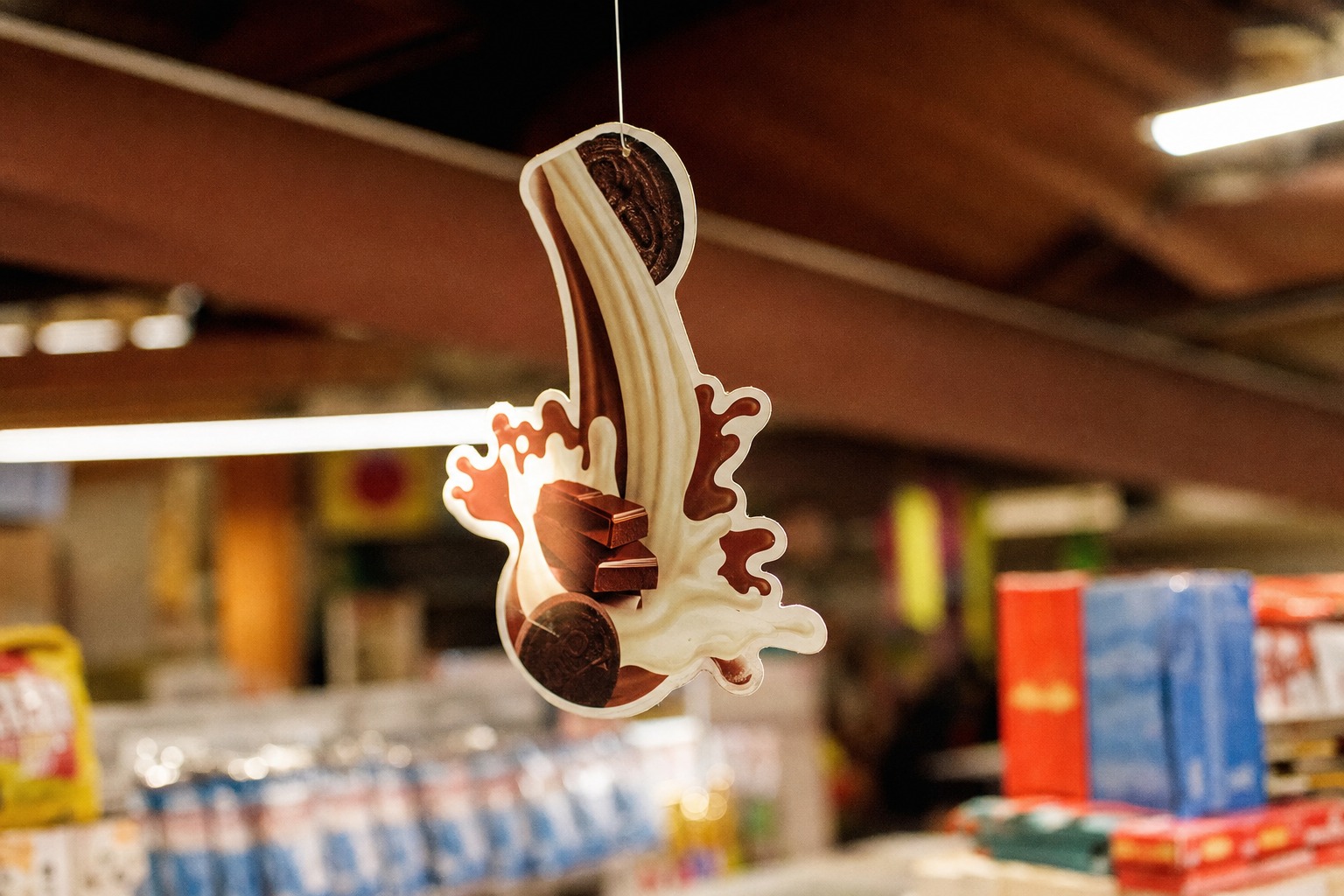
A dangler is a lightweight, printed promotional sign used to draw attention to a product, offer, department, launch, or brand message at the point of sale.
“Dangler” is a common print and retail merchandising term rather than a formal display standard. It generally refers to a hanging point-of-sale display used in stores, showrooms, exhibitions, and event environments.
These displays can be simple rectangular signs, custom die-cut shapes, branded product silhouettes, arrows, or multi-part constructions. Depending on where they hang, they may also be called ceiling signs, retail hanging signs, suspended displays, or hanging POS materials.
Their defining feature is not a particular shape or material. It is the fact that they hang in a visible position and direct shoppers toward a message.
What does dangler mean in grammar?
In grammar, a dangler usually means a dangling modifier: a descriptive word or phrase that does not clearly modify the intended subject of a sentence. The result can be confusing or unintentionally funny because the modifier appears to describe the wrong person or object.
Consider this sentence:
Walking into the store, the ceiling sign caught Maya’s eye.
The introductory phrase appears to modify “the ceiling sign,” suggesting that the sign walked into the store. The intended subject is Maya. The sentence can be corrected by placing her directly after the phrase:
Walking into the store, Maya noticed the ceiling sign.
A dangling participle is a common type of dangling modifier. It begins with a participle, such as “walking,” “looking,” or “finished,” but the sentence does not provide the right subject for that phrase.
For example:
Finished with the artwork, the files were sent to the printer.
This construction suggests that the files finished the artwork. A clearer sentence would be:
After the designer finished the artwork, the files were sent to the printer.
Not every dangling modifier is technically a dangling participle, but the terms are often used together. In either case, the usual correction is to identify who or what performs the action and place that subject next to the modifier.
What does dangler mean in a story?
In discussions of fiction, television, and film, a dangler can be an unresolved plotline, question, relationship, or clue. The writer introduces it but does not resolve it within the expected part of the story.
An unresolved plotline may be intentional. Writers sometimes use it as a plot device to create suspense, support a sequel, or leave room for interpretation. A mystery revealed at the end of an episode, for example, can lead into the next instalment.
It can also be accidental. A secondary character may disappear without explanation, or an important clue may never affect the outcome. In that case, readers may view the unresolved element as an abandoned plotline rather than an effective plot device.
This usage is less standardized than the grammar or printing definitions. Terms such as “dangling plot thread,” “loose end,” and “unresolved storyline” are more common.
What are dangler earrings?
Dangler earrings are earrings that extend below the earlobe rather than sitting directly against it. They may use chains, beads, stones, metal shapes, or other decorative elements that move as the wearer moves.
The terms dangle earrings and drop earrings often overlap. Some jewellery sellers use drop earrings for relatively fixed designs that hang below the earlobe and reserve dangler earrings for longer, more flexible styles that swing freely. Others use all three terms interchangeably, so product dimensions and photographs provide a more reliable distinction than the name alone.
How does a retail hanging display work?
A retail hanging display places a concise promotional message above or within the shopper’s normal field of view. Its suspended position helps it stand apart from packaging, shelf labels, and other visual material at product level.
The sign is usually attached with line, cord, hooks, clips, adhesive hardware, or a retailer-approved hanging system. Air movement can create slight motion, although the display should remain readable and safely controlled.
These signs commonly perform one or more retail functions:
- Announce a promotion or limited-time offer
- Identify a product category or store department
- Direct shoppers toward an aisle, display, or service area
- Support a seasonal campaign
- Introduce a new product or packaging design
- Reinforce brand recognition
- Connect an overhead message with a shelf or floor display
Unlike permanent store signage, hanging promotional pieces are often produced for a defined campaign period. They can be packed with other printed components and distributed as part of a coordinated store rollout.
Where are hanging signs used?
Retail danglers are most often used in stores, but they also work in showrooms, trade shows, exhibitions, restaurants, service counters, and branded event spaces. The best location offers clear visibility without obstructing customers, staff, lighting, sprinklers, or security equipment.
Common placements include:
- Above promotional islands and endcaps
- Over checkout areas
- Near store entrances
- Above selected aisles
- Over product demonstrations
- In storefront or interior windows
- Beside seasonal displays
- Above service desks or pickup counters
A ceiling-mounted sign can guide customers from a distance, while a smaller fixture-mounted version can focus attention on a specific product group. In both cases, placement should support the shopper’s path through the store.
Installation rules vary by retailer and building. Before production, the campaign team should confirm approved hanging locations, maximum dimensions, mounting methods, ceiling conditions, and applicable safety requirements.
What are printed danglers made from?
Printed danglers are usually made from lightweight materials that provide enough stiffness to hang flat while remaining practical to install and ship. Paperboard, cardboard, PVC, synthetic sheet, and acrylic are among the materials used, with the final choice depending on the environment and intended lifespan.
Paperboard and cardboard
Paperboard is suitable for many short-term indoor promotions. It prints well, supports custom die-cutting, and can be produced in a wide range of shapes.
Corrugated or heavier display board may be appropriate for larger signs that need more rigidity. The flute, thickness, edge appearance, and print method should be selected according to the display size and viewing distance.
Synthetic and plastic-based materials
Synthetic sheets or lightweight plastic materials may be considered where moisture resistance, repeated handling, or longer use is expected. Suitability varies by material, store environment, municipal requirements, and the retailer’s sustainability policies.
Rigid materials
Acrylic and other rigid substrates can create a more permanent appearance, but weight becomes an important installation consideration. Hanging hardware and ceiling support must be appropriate for the finished piece.
Accent Impression produces POP / POS displays, including custom suspended signs, on its own presses in Montreal and can kit them for multi-store retail rollouts across Canada.
How are hanging displays printed and finished?
Hanging displays can be printed digitally or by offset printing, depending on quantity, dimensions, substrate, colour requirements, and versioning. A printer should recommend the production method after reviewing the complete job rather than quantity alone.
Many are printed on both sides so the promotion can be seen from different directions. Two-sided construction is particularly useful in open aisles, entrance areas, and overhead locations where shoppers approach from more than one angle.
Available finishing options may include:
- Custom die-cutting
- Drilled or punched hanging holes
- Reinforced attachment points
- Lamination
- Protective coatings
- Foil accents
- Embossing
- Scoring and folding
- Grommets or eyelets
- Attachment hardware
A custom shape can connect the sign visually to a product, mascot, logo, or seasonal theme. However, narrow extensions and intricate cut areas should be reviewed for strength, especially if the piece will move after installation.
The attachment point must also be included in the design. A hole placed too close to an edge can weaken the sign, while an off-centre hole may cause it to hang at an unintended angle.
What makes a dangler design effective?
An effective dangler communicates one main idea quickly and remains legible from its intended viewing distance. Strong hierarchy, restrained copy, recognizable branding, and sufficient contrast matter more than filling every available area.
One message should lead
A hanging sign is not a brochure. It should usually focus on one promotion, category, product benefit, or directional instruction.
A practical message hierarchy might include:
- The main offer or announcement
- The product or brand identifier
- A short supporting detail
- A directional cue or campaign condition, if required
Legal copy and promotional conditions still need to be included where applicable, but they should not overwhelm the main message.
Both sides need to be planned
A two-sided sign does not always require identical artwork. One side might attract shoppers entering an aisle, while the other directs them toward the promoted display.
Designers should confirm whether the piece will rotate. If it can turn freely, both sides should make sense from multiple approaches.
Shape should support recognition
Die-cut shapes can make the display easier to recognize, especially when they reflect the product or campaign. A beverage bottle, leaf, gift box, arrow, or product silhouette can communicate before the shopper reads the copy.
Shape should not compromise readability or installation. The hanging sign still needs enough stable area for the message and attachment point.
Quebec and national copy needs planning
For Quebec retail programs, approved French copy should be built into the layout and proofreading process from the start. National campaigns may require French and English versions, bilingual artwork, or store-specific language allocation.
Version requirements should be settled before imposition and printing. Late copy changes can affect artwork, quantities, packing lists, and store-level distribution.
How should a multi-store rollout be planned?
A multi-store rollout should treat the suspended sign as part of a complete retail-print program, not as an isolated item. Production quantities, store allocation, installation hardware, packing, instructions, and delivery dates all need to align.
A typical workflow includes:
- Confirming store locations and installation conditions
- Establishing finished size, substrate, and hanging method
- Creating and testing the dieline
- Approving language and regional versions
- Producing a physical or colour proof where appropriate
- Printing, cutting, and finishing the displays
- Sorting units by store or region
- Adding hardware and installation instructions
- Packing with related campaign materials
- Shipping according to the rollout schedule
Kitting can reduce work at store level. Each location can receive the correct number of signs together with shelf talkers, window graphics, floor graphics, labels, or other campaign components.
The package should identify its destination and contents clearly. Installation instructions should show the intended orientation, approved mounting point, and finished appearance.
How is a dangler different from other retail displays?
A dangler hangs freely or semi-freely, while most other small retail displays attach directly to a shelf, wall, floor, or fixture. The distinction matters because each format occupies a different part of the customer’s field of view.
Dangler versus shelf talker
A shelf talker attaches at or near the shelf edge. It brings attention to a particular product where the buying decision occurs, while a suspended display can attract attention from farther away.
Dangler versus wobbler
A wobbler usually extends from a shelf on a flexible strip or stem. It moves when touched or disturbed, but it remains anchored to the shelf rather than hanging overhead.
Dangler versus aisle violator
An aisle violator typically projects perpendicular to the shelf so shoppers can see it while looking down the aisle. A dangler is suspended from above or from another fixture.
Dangler versus hanging sign
“Hanging sign” is a broader term. It can describe large permanent directional signage, department markers, or temporary promotions. A dangler is generally lighter and more campaign-focused.
Retail terminology is not completely standardized. A drawing, installation photo, or physical sample should accompany a print request so the printer and buyer are discussing the same format.
Frequently asked questions about printed hanging signs
Most buyer questions concern size, sidedness, installation, durability, and production planning. The correct specification depends on the store environment and campaign requirements.
Are retail danglers printed on both sides?
They often are, especially when customers can approach from two directions or the sign may rotate. Single-sided printing may be sufficient when the back faces a wall or window structure.
What size should a retail hanging sign be?
There is no universal size. It depends on ceiling height, viewing distance, available space, message length, substrate stiffness, and retailer guidelines. A full-scale mockup can help confirm visibility before production.
Can a hanging display be custom die-cut?
Yes. Paperboard and many display substrates can be cut into custom shapes, subject to material and structural limitations. The printer should review fine details, narrow sections, and hanging points before approving the dieline.
How is a retail dangler installed?
Installation may use line, cord, clips, hooks, rails, adhesive fixtures, or other retailer-approved hardware. The selected method must suit the display’s weight, the mounting surface, and the location’s safety rules.
How long does a printed hanging sign last?
Service life varies by material, exposure, handling, airflow, and installation conditions. Paperboard is commonly used for temporary indoor campaigns, while more durable substrates may be appropriate for longer programs or demanding environments.
Can hanging signs be packed by store?
Yes. They can be counted, bundled, labelled, and packed according to store-level allocation data. Hardware and instructions can also be included with each kit, along with the campaign’s other printed display components.
Request a quote
Have a print or packaging project? Talk to our team. We take it from concept to delivery, on our own presses, here in Montreal.