
Where to find postcard printing Montreal services
The best place to print and mail postcards in Montreal is a commercial printer with integrated lettershop services, not simply a shop that produces cards. Look for one provider that can print, address, sort and submit the campaign to Canada Post.
Keeping production and mailing under one roof reduces handoffs and gives the supplier responsibility for the complete job. This is especially valuable for direct mail campaigns involving multiple store regions, bilingual creative, customer segments or coordinated arrival dates.
When comparing postcard printing Montreal services, confirm that the provider offers:
- Offset and digital postcard printing
- Full colour and two-sided printing
- Variable-data printing and addressing
- Mailing-list processing and duplicate removal
- Postal preparation and sorting
- Postal submission
- Proofing before production
- Bilingual campaign support
- Reporting or confirmation of mailing
- Secure handling and deletion of customer data
A print-only supplier may still be suitable when postcards will be handed out, packed into orders or delivered to stores. For addressed campaigns, however, a complete print-and-mail service is usually the more practical choice.
Postcard sizes and postal specifications
Postcard dimensions, thickness, weight and layout must be checked against the selected Canada Post service before artwork is approved. A format that prints correctly is not automatically eligible for the intended mailing rate or processing method.
Common finished sizes
Popular marketing formats include 4×6, 5 x 7, 5.5 x 8.5 and 6 x 9 inches. Smaller cards are economical and familiar, while larger formats provide more space for product photography, store information and promotional details.
The right size depends on the message:
- 4×6 inches: Short announcements, thank-you cards and simple offers
- 5 x 7 inches: Local promotions, invitations and service reminders
- 5.5 x 8.5 inches: Retail events, menus and campaigns with several products
- 6 x 9 inches: High-visibility promotions and image-led creative
Postal eligibility varies by format and mailing service. Before choosing a non-standard size, ask the mail provider to confirm the dimensional, thickness, aspect-ratio and weight requirements for the campaign.
Address and postal areas
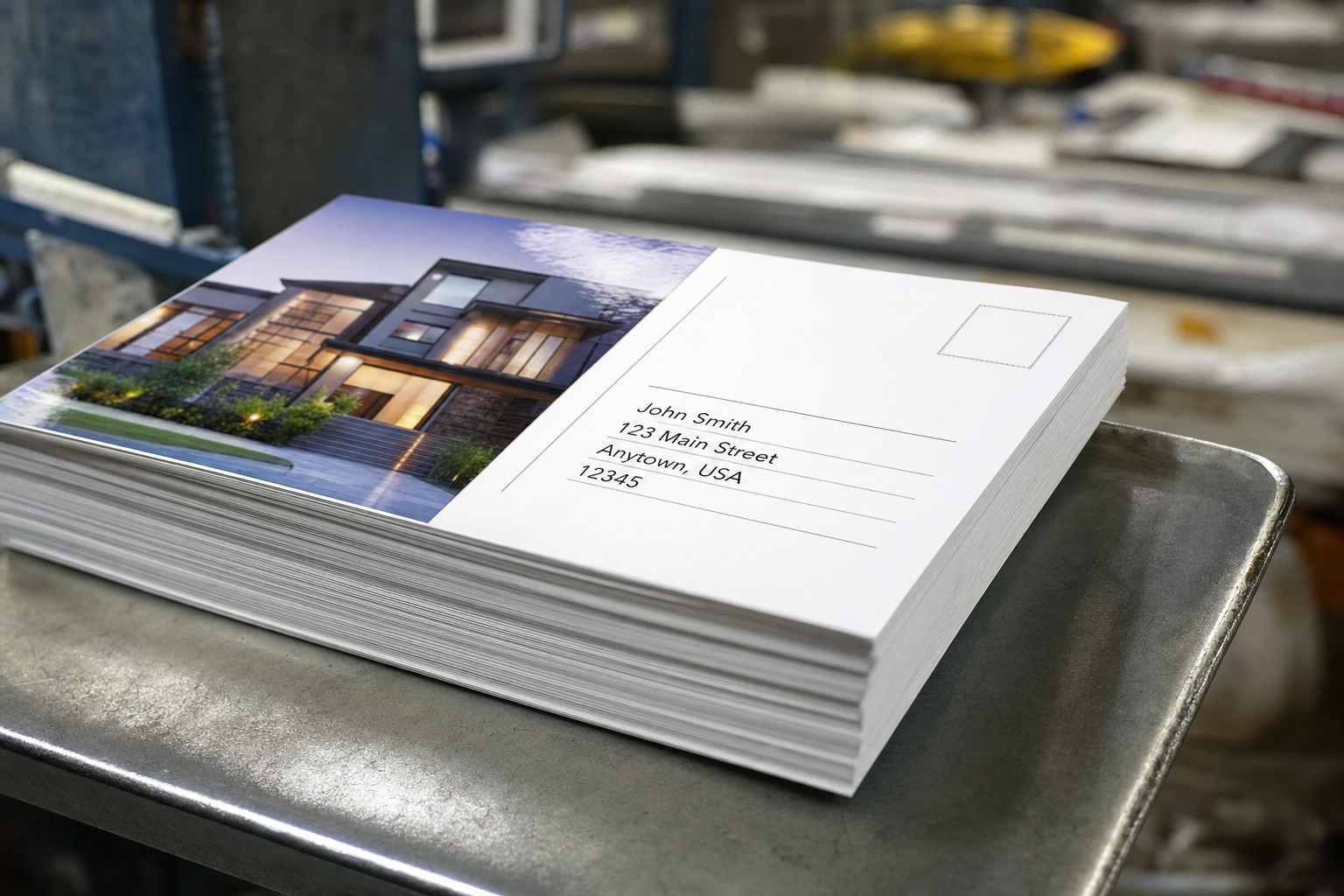
The mailing panel needs enough clear space for the recipient address, indicia and any postal markings required for automated handling. Placing essential text, QR codes or offer details in that area can create production problems.
Have the printer provide a mailing template before design begins. The template should show:
- Finished dimensions
- Bleed and trim lines
- Safe zones
- Address block
- Indicia position
- Barcode or clear-zone requirements
- Return-address placement
This is particularly important for bilingual or two-sided layouts, where additional copy can quickly crowd the available space.
Paper, coating and finishing options
A postcard should be rigid enough to travel through the mail while matching the campaign’s visual and practical requirements. Cardstock, coating and finish should be selected together rather than treated as separate decisions.
Card stock
Postcards are commonly produced on coated cover stock, uncoated cover stock or heavier board. Depending on the printer, common choices may include 14pt and 16pt cardstock. Some Montreal print listings offer options such as 12 pt and 16 pt card stock with gloss or matte lamination, illustrating the range available for local print-only orders.
A heavier stock can create a more substantial impression, but thickness may affect postal compatibility and cost. Always confirm the selected material with the mail department before ordering.
Coated versus uncoated paper
Gloss-coated stock strengthens colour and image contrast, making it suitable for food, fashion, home improvement and product photography. A gloss finish can give full colour images greater visual impact, although glare and addressability must also be considered. Matte or silk surfaces reduce glare and offer a more restrained appearance.
Uncoated stock has a tactile, natural feel and is easier to write on. It works well for appointment cards, personalized notes, community campaigns and postcards that include a writable field.
Protective and decorative finishes
Lamination, aqueous coating and UV coating can improve durability, but the address area must remain compatible with inkjet addressing, toner or labels. A highly glossy coating across the entire mailing side may interfere with personalization.
Optional finishes include:
- Matte or gloss lamination
- Spot UV
- Foil stamping
- Embossing
- Die-cut corners or custom shapes
- Perforations for coupons or reply sections
Special shapes and heavy finishes should be reviewed for machine compatibility. An unusual card may require different preparation or manual handling, so its postal impact and turnaround time can vary by job.
Digital, offset and variable-data printing
Digital printing is generally suited to shorter quantities and personalized campaigns, while offset printing becomes attractive for larger, consistent runs. Businesses researching postcard printing Montreal options should ask the printer to compare both methods based on total campaign requirements, not unit print price alone.
Digital printing
Digital production supports short runs, fast version changes and variable content. Each postcard can contain a different name, store location, offer, image, language or QR code.
It is a practical option for:
- Neighbourhood-level targeting
- Customer reactivation
- Loyalty campaigns
- Dealer or franchise versions
- Test campaigns
- Store-specific offers
Offset printing
Offset is typically considered for larger volumes with common artwork. It provides consistent colour and broad stock and finishing flexibility, although exact cost advantages depend on quantity, versions, schedule and finishing.
A hybrid workflow can also make sense. The main artwork is printed offset, then addresses or personalized elements are added digitally.
Accent Impression produces and mails postcard campaigns through its dedicated direct mail service, with printing and data-driven personalization managed in Montreal.
Mailing-list preparation and personalization
A reliable mail provider should inspect and process the mailing data before addressing begins. Clean data helps prevent duplicates, malformed records and pieces sent to incomplete addresses.
Ask what the quoted data work includes. Typical services may cover:
- Field mapping and file setup
- Duplicate identification
- Address standardization
- Province and postal-code checks
- Suppression-file processing
- Language or geographic segmentation
- Seed records for campaign monitoring
- Variable-text and image setup
Montreal campaigns often require French and English versions. Language preference should be supplied as a clear database field rather than inferred during production.
Full-service mailing operations can combine data processing, addressing, tabbing and variable-data printing through a Canada Post-connected partner workflow. Confirm which tasks are completed in-house and which are outsourced, particularly when the file contains customer information.
For privacy and procurement review, ask how files are transferred, who can access them, how long they are retained and when they are deleted.
Retail and business postcard use cases
Postcards work best when they deliver one clear message, a specific reason to respond and an obvious next step. For retailers, they can connect a household audience to a nearby store, promotion or event.
Retail openings and multi-store promotions
A postcard can announce a new location, seasonal event, loyalty offer or limited-time promotion. Store-specific variable data allows one campaign to direct recipients to different addresses without creating separate manual jobs.
For a multi-store rollout, coordinate the postcard with in-store materials such as:
- Window posters
- Counter cards
- Shelf talkers
- Floor decals
- Product labels
- Point-of-purchase displays
- Promotional kits
Matching production schedules helps ensure the postcard does not arrive before store teams have installed the related promotion.
Local service campaigns
Clinics, dealerships, restaurants, real estate teams and home-service companies can target defined neighbourhoods around a location. Useful messages include appointment reminders, seasonal services, event invitations and customer reactivation offers.
Neighbourhood Mail may be considered when the campaign targets geographic areas rather than a list of named recipients. Coverage, format and preparation requirements should be confirmed before the design and quantity are finalized.
Personalized customer offers
Customer-history fields can support different messages for new, active and inactive buyers. Unique promotion codes, personalized URLs and QR codes can also help connect responses to a particular audience or creative version.
Only use data that is appropriate for the campaign and approved through the organization’s privacy process.
How to compare print-and-mail quotes
Compare quotes using total campaign cost and included services, not postcard printing price alone. A low print price may exclude data work, addressing, proofs, postal preparation, postal submission or postage.
Request an itemized estimate showing:
- Finished size and quantity
- Number of artwork versions
- One-sided or two-sided printing
- Printing method
- Stock and coating
- Finishing
- Data processing
- Variable imaging
- Addressing method
- Postal preparation
- Transportation or postal submission
- Postage estimate
- Tax
- Overs and unders policy
- Production and mailing schedule
- Expected turnaround time
Postage should normally be shown separately because it depends on format, weight, quantity, preparation and the selected mailing service.
Also ask whether the quote is based on the number of records received or the number of valid pieces mailed. Data cleanup can change the final quantity. Quotes from postcard printing Montreal providers should be compared using the same size, stock, quantity, finishing and data assumptions.
Artwork, proofing and production decisions
A production-ready postcard needs correct bleed, image resolution, colour settings and postal clear zones. The safest workflow uses the printer’s template and includes approval of both artwork and personalized records.
The proofing process should cover:
- Static front and back artwork
- Trim, bleed and safe margins
- Mailing-panel placement
- Sample names and addresses
- Longest variable fields
- French and English versions
- QR codes, URLs and promotion codes
- Final stock and finish
A physical proof may be useful when colour, stock feel or finishing is critical. For routine campaigns, a PDF proof and variable-data sample may be sufficient. Proof requirements and turnaround vary by job.
Do not assume the mailing date is the delivery date. Production approval, data processing, postal induction and delivery are separate stages. Build the schedule backward from the promotion date and leave room for proof corrections.
Frequently asked questions
Printing and mailing postcards involves decisions about format, data, production and postal preparation. These are the questions Montreal buyers most often need answered before requesting a quote.
Can one Montreal company print, address and mail the postcards?
Yes, a full-service commercial printer or lettershop can manage printing, personalization, addressing, sorting and Canada Post submission. Confirm that these services are included in the estimate rather than coordinated through separate suppliers.
What files are needed for a postcard mailing?
Most providers need print-ready artwork plus a spreadsheet or database containing the mailing fields. Ask for the preferred PDF settings, spreadsheet format, column structure and secure upload method before submitting files.
Can every postcard have a different name or offer?
Yes. Variable-data printing can change names, addresses, images, language, store details, QR codes and promotional offers from one piece to the next. Complexity, testing and pricing vary by job.
Should postcards be printed digitally or offset?
Digital printing is usually considered for shorter, personalized or multi-version runs. Offset is often evaluated for larger quantities with common artwork. A printer can compare the complete costs once quantity, versions, stock and schedule are known.
How early should a postcard campaign be booked?
Allow time for artwork review, data processing, proof approval, production, finishing, postal preparation and delivery. The required lead time varies by quantity, complexity and mailing service, so schedule backward from the date recipients should act.
Can postcards be coordinated with a retail rollout?
Yes. Postcards can be produced alongside window signage, POP displays, shelf materials, labels and store kits. Coordinating mailing and store installation helps keep the customer message consistent across home and in-store touchpoints.
Request a quote
Have a print or packaging project? Talk to our team. We take it from concept to delivery, on our own presses, here in Montreal.