
The core POS materials for a complete retail program
The point-of-sale (POS) materials every retail store needs are promotional signs, product displays, counter materials, printed inserts and branded packaging. Together, they guide shoppers from product discovery through purchase while keeping pricing and campaign messaging consistent.
In this guide, point-of-sale (POS) materials refers primarily to printed pieces, sometimes called point-of-purchase or POP materials. It does not refer to the transaction hardware that forms part of a POS system, although both categories contribute to an efficient customer experience.
A practical core program includes:
- Posters and window graphics
- Shelf talkers, shelf strips and price cards
- End-cap signage and product displays
- Counter cards, counter mats and impulse units
- Floor decals and queue signs
- Coupons, flyers and promotional inserts
- Loyalty cards and application materials
- Branded bags, boxes and tissue paper
These promotional materials should not be treated as isolated print orders. They work best as a coordinated system, with each item assigned to a store location, campaign objective and stage of the buying journey.
Printed materials versus POS system hardware
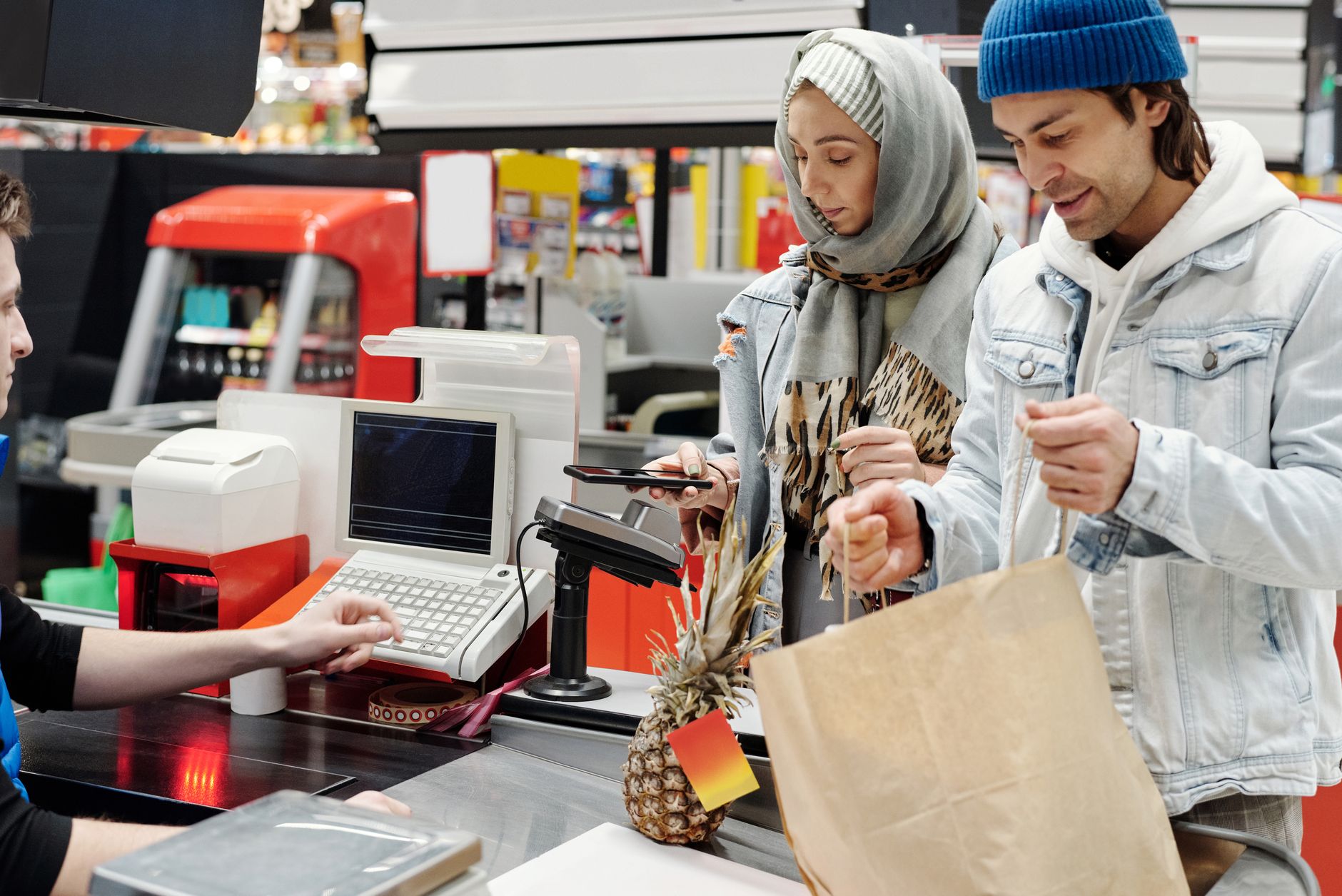
A retail store also requires operational equipment for processing transactions. A typical POS system may include a computer or tablet, payment terminal, barcode scanner, receipt printer and cash drawer, supported by software for sales reporting and inventory management.
The barcode scanner identifies products and helps reduce manual entry, while the receipt printer creates a physical record of the transaction when one is required. The cash drawer stores notes and coins for cash payments. These components are essential to many retail operations, but they are not printed POS materials.
Print and hardware still need to work together. Shelf prices, promotional offers and product codes should match the information in the POS system. This coordination supports accurate transactions, reliable inventory management and a more consistent customer experience.
Posters, window graphics and overhead signage
Posters and large-format signs provide broad visibility for promotions, seasonal messages and brand campaigns. Buyers should select their format according to viewing distance, installation method, lighting and expected campaign duration.
Common applications
Window graphics reach shoppers before they enter. Wall posters reinforce campaigns inside the store, while hanging signs help customers navigate departments or spot an offer from farther down an aisle.
Common options include:
- Paper posters for frames or short-term indoor promotions
- Rigid board signs for easels, wall mounts and overhead fixtures
- Removable window vinyl for temporary campaigns
- Static-cling graphics for smooth glass surfaces
- Double-sided hanging signs for visibility from both directions
- Fabric graphics for reusable frames or premium environments
High-contrast visuals, concise copy and large type make signs easier to understand in busy retail environments. Point-of-sale (POS) materials are most effective when placed at eye level or in high-traffic areas such as aisle ends and checkout counters.
Specifications to confirm
Provide the printer with finished dimensions, quantity by version, single-sided or double-sided printing, indoor or outdoor use, and the installation method. For window materials, clarify whether graphics must be read from outside, inside or both.
Outdoor and sun-exposed applications may require weather-resistant substrates, suitable inks and protective lamination. The appropriate construction varies by job, exposure and required lifespan.
Shelf talkers, shelf strips and price cards
Shelf-level POS materials place product information and promotional messages directly beside the merchandise. They are particularly useful for prices, product benefits, comparisons, limited-time offers and new-product launches.
Shelf talkers and wobblers
Shelf talkers project from the shelf edge, giving a message more visibility than a standard price label. Wobblers use a flexible strip or spring-like attachment to create movement when air circulates or shoppers pass.
Buyers should confirm:
- Available shelf-edge space
- Finished shape and dimensions
- Attachment method
- Required stiffness
- Whether the piece needs to be removable
- Number of products, stores and language versions
- Campaign duration
Die-cut shapes can help a shelf piece stand out, but they should not block products, price labels or required information. The message should remain readable without forcing the customer to stop and study it.
Shelf strips and price cards
Shelf strips organize longer runs of pricing, category information or brand messaging. Price cards support quick updates and should be printed for legibility, particularly when small type, multiple prices or promotional conditions are involved.
Retail execution depends on accurate placement. Store standards commonly cover the correct use of POS materials, product positioning and compliance with brand guidelines, so every shelf component should correspond to a clear planogram location or installation instruction.
Prices and product identifiers should also match the POS system. When offers change, updates may be required in both the printed pieces and the store’s sales or inventory management software.
End caps, freestanding units and product displays
Retail displays turn printed material into a merchandising structure that holds, surrounds or organizes products. The right format depends on product weight, replenishment frequency, available floor space and the number of stores receiving the campaign.
End-cap units
End caps take advantage of high-traffic positions at the ends of aisles. They may use header cards, side panels, shelf strips, trays or a complete printed surround fitted to existing shelving.
Measure the retailer’s fixture before production. Small differences in shelf width, height or lip depth can affect installation and appearance.
Freestanding units and product stands
Freestanding units, often called FSUs, create a dedicated branded area away from standard shelving. They can be produced from corrugated board for temporary campaigns or more durable materials for longer programs.
Important decisions include:
- Product dimensions and total loaded weight
- Number of product facings
- Maximum unit footprint
- Flat-packed or pre-assembled delivery
- Restocking access
- Required campaign lifespan
- Store installation skill level
- Disposal or recyclability requirements
Accent Impression produces retail displays & POP materials and kits them for multi-store rollouts across Canada using its in-house print production capabilities.
Dump bins and counter displays
Dump bins suit packaged products that shoppers can browse without precise facing. Counter displays are better for smaller products, samples and impulse purchases near the register.
Structural testing is important for any unit that carries merchandise. A printer should review the product sample, packed weight and expected handling before recommending board grade, flute, reinforcement or finishing.
Checkout and queue-management materials
Checkout POS materials encourage final purchases, explain loyalty programs and organize customer flow. Their specifications should account for heavy handling, limited counter space and frequent cleaning.
Useful formats include:
- Counter cards and tent cards
- Counter mats
- Small product trays
- Loyalty cards and enrollment inserts
- Coupon dispensers
- Floor decals
- Queue-direction signs
- Pickup and returns signs
Counter mats may require a wipeable surface or non-slip backing. Floor graphics need an adhesive and surface treatment appropriate for the flooring, traffic level and cleaning routine. Installation and removal requirements should be confirmed before selecting the material.
Floor decals should also be placed where they remain visible without creating confusion or interfering with accessibility. In checkout zones, messaging must be brief enough to understand while the shopper is moving through the queue.
Printed offers near the register should match the promotion programmed into the POS system. Staff should also be able to reach the payment terminal, barcode scanner, receipt printer and cash drawer without printed pieces obstructing the transaction area.
Coupons, flyers and promotional inserts
Printed promotional materials give shoppers an offer or message they can take away. Coupons, flyers and brochures can support repeat visits, product education, cross-selling and loyalty-program enrollment.
The most suitable format depends on the amount of content and how the item will be distributed.
- Use a coupon for one clear incentive and redemption condition.
- Use a flyer for multiple products, prices or store events.
- Use a brochure when the shopper needs more detailed information.
- Use a package insert for instructions, cross-promotions or a future-purchase offer.
- Use a loyalty card when a durable, wallet-sized identifier is required.
Specify whether pieces will be handed out, placed in a holder, packed with an order or inserted automatically. This affects finished size, folding, paper choice and bundling.
Promotional conditions should be easy to find and read. Before printing, verify offer dates, participating locations, exclusions, barcodes and applicable English and French content. Quebec retailers should have their legal or compliance team review language requirements for the specific application.
Coupon barcodes should be tested against the intended barcode scanner and transaction software before the full run is produced. Any printed discount must also correspond to a valid offer in the retailer’s system.
Branded bags, boxes and tissue paper
Branded packaging carries the retail experience beyond the checkout. Bags, boxes, labels, seals and tissue paper can protect the purchase while extending campaign and brand visibility.
Bags and tissue
Paper bags can be printed in standard or custom sizes with several handle options. Buyers should consider product weight, bag dimensions, print coverage and whether the bag must support food, apparel or irregularly shaped merchandise.
Printed tissue adds branding without changing the primary package. Confirm sheet size, colour coverage and whether ink or material requirements apply to the packed product.
Retail boxes and labels
Folding cartons and corrugated boxes can be designed for shelf presentation, gift packaging, e-commerce pickup or promotional kits. Labels can identify variants, add bilingual information or adapt standard packaging for a limited campaign.
Finishing options include:
- Die-cut windows and custom shapes
- Foil stamping
- Embossing or debossing
- Spot coatings
- Protective lamination
- Tamper-evident seals
- Custom inserts
Premium finishing should support the positioning of the product rather than make important text harder to read. Request a physical prototype for packages with unusual structures, heavier contents or automated packing requirements.
How to choose materials and print specifications
Choose point-of-sale (POS) materials by starting with placement, campaign duration, store conditions and rollout method. Substrate, finishing and packing decisions should follow those operational requirements, not precede them.
Match the material to the lifespan
Paper and lightweight board often suit short indoor campaigns. Rigid board, corrugated structures, plastics, fabric and laminated materials may be appropriate for longer use or more demanding environments.
There is no universal durability specification. It varies by location, handling, cleaning, moisture, sunlight and whether the material holds merchandise.
Choose digital or offset printing
Digital printing is generally useful for shorter runs, multiple versions and location-specific content. Offset printing can be suitable for larger quantities requiring consistent reproduction across a long run.
A mixed retail program may use both. For example, a national campaign could use offset-printed core pieces and digitally printed price cards or store-specific kits.
Plan finishing and installation
Die-cutting creates custom shapes, while scoring and folding turn flat sheets into stands, sleeves and cartons. Lamination or coating can add protection where appropriate.
Also determine who will install the materials. A complex merchandising unit may look impressive at approval but fail in stores if assembly takes too long or instructions are unclear. Flat-packed items should include labelled components and concise assembly guidance.
Kitting POS materials for multi-store rollouts
Kitting groups each store’s signs, merchandising pieces and promotional materials into a location-specific package. It reduces sorting at store level and helps retailers control versions, quantities and campaign launch dates.
A useful store kit may include:
- A packing list
- Pieces labelled by department or installation zone
- Store-specific prices and offers
- Bilingual or regional versions
- Assembly instructions
- Installation diagrams
- Hardware, adhesives or fasteners
- Extra copies of easily damaged pieces
The kit plan should be created before printing. Provide a store list, quantities by location, language requirements, delivery windows and any differences in fixture size. Numbering cartons and matching them to packing lists makes rollout verification easier.
For campaigns involving unique prices or product codes, store-level kit data should be checked against the retailer’s system records. This helps prevent differences between the printed offer and the amount shown at the register.
Frequently asked questions about retail POS materials
POS buying decisions usually come down to terminology, durability, quantities, artwork and rollout logistics. These answers address the questions that most often affect production.
What is the difference between POS and POP materials?
POS materials are commonly associated with the checkout or transaction area, while POP materials can appear anywhere shoppers make product decisions. In practice, retailers and printers often use the terms interchangeably for in-store promotional print and merchandising pieces.
Neither term should automatically be confused with a POS system. The system refers to the hardware and software used to process sales, record transactions and support related retail operations.
Which POS materials should a small retail store buy first?
A small retail store should start with window or entrance signs, shelf-level price and promotional pieces, counter materials, and branded packaging. Add floor graphics or freestanding displays when there is enough space and a clear merchandising purpose.
How far in advance should POS materials be ordered?
Lead time varies by job. Simple digitally printed signs may require less time than custom die-cut structures, packaging or multi-location kits. Allow additional time for prototypes, retailer approval, bilingual artwork, assembly and freight.
Should retail displays arrive flat-packed or assembled?
Flat-packed displays usually reduce shipping volume, while assembled units reduce store labour. The best choice depends on freight costs, available storage, structural complexity and the ability of store teams to complete assembly correctly.
Can each store receive different prices or offers?
Yes. Digital printing and variable-data workflows can support location-specific prices, languages, barcodes and offers. Accurate store data and a controlled proofing process are essential.
What artwork files does a POS printer need?
Print-ready PDF files are commonly preferred, with bleed, fonts, images and dielines prepared to the printer’s specifications. For structural pieces and packaging, request the printer’s approved dieline before finalizing artwork.
Final buying checklist
A complete POS order should define what is being printed, where it will be installed and how it will reach each retail store. Confirm these details before approving production:
- Finished size and quantity for every component
- Store, region and language versions
- Indoor or outdoor placement
- Expected campaign duration
- Viewing distance and lighting
- Product weight for load-bearing units
- Fixture measurements and planogram position
- Substrate, coating and finishing requirements
- Adhesive, hanging or mounting method
- Flat-packed or assembled delivery
- Kitting, labelling and packing-list requirements
- Prototype and proof approvals
- Barcode and offer testing
- Alignment with system prices and product records
- Delivery dates by store or distribution centre
- Installation and removal instructions
Request a quote
Have a print or packaging project? Talk to our team. We take it from concept to delivery, on our own presses, here in Montreal.