

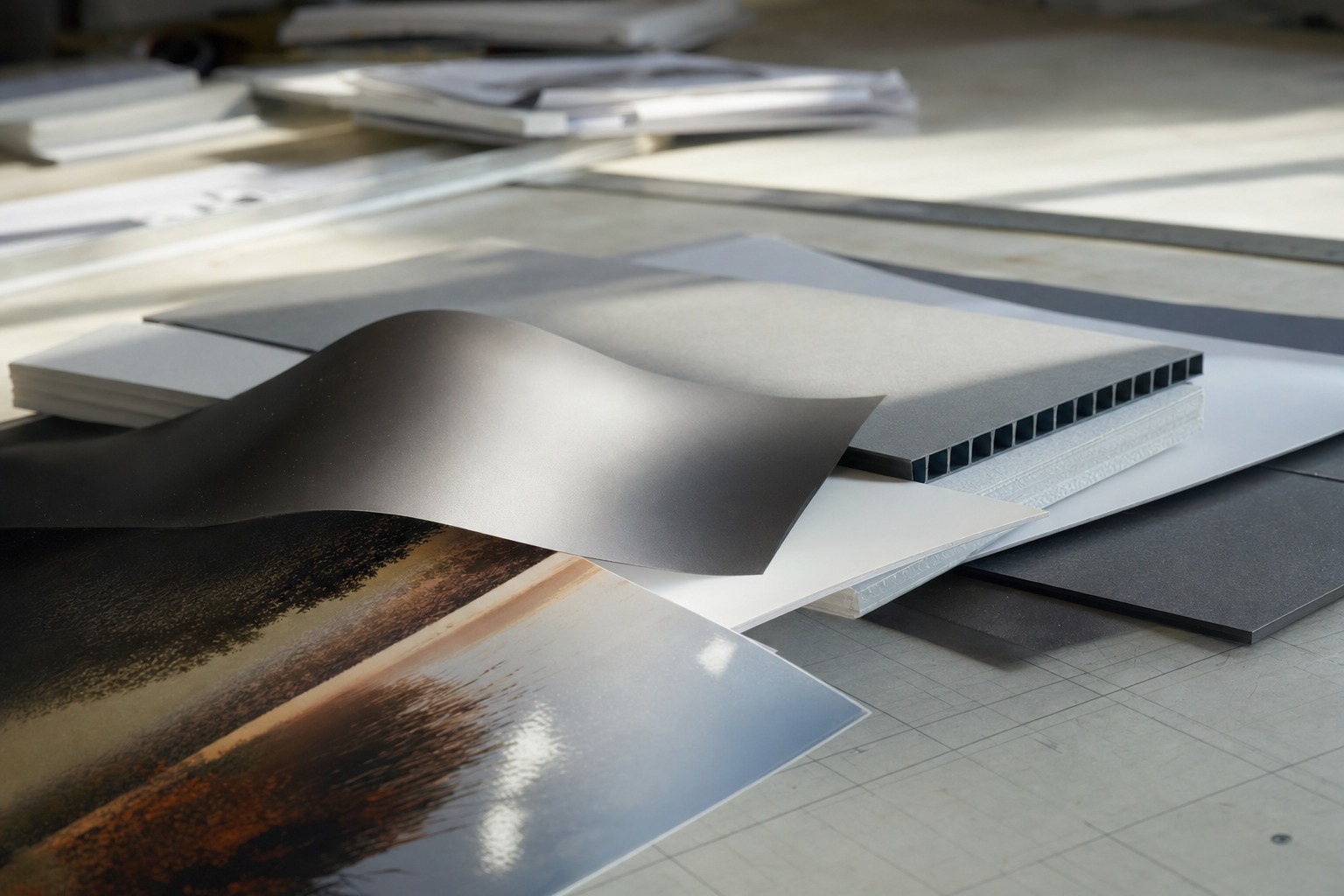
What are durable print substrates?
Durable print substrates are materials engineered to resist moisture, tearing, abrasion, chemicals, temperature changes, or prolonged handling better than ordinary paper. The right choice depends on the complete printed system, including ink, coating, laminate, adhesive, finishing, installation, and exposure conditions.
These printing substrates include synthetic paper, pressure-sensitive films, rigid plastics, weather-resistant boards, aluminum panels, and other specialty materials. Each solves a different problem. A waterproof menu does not need the same construction as a floor graphic, warehouse label, or outdoor retail sign.
For buyers, the most useful first step is to define what “durable” means for the job:
- Water and humidity resistance
- Tear and puncture resistance
- Abrasion and scuff resistance
- Resistance to grease, cleaners, oils, or chemicals
- UV and weather resistance
- Dimensional stability under heat or temperature changes
- Adhesion to a specific surface
- Repeated handling, folding, or cleaning
- Legibility throughout the required service period
A material can survive rain while its ink fades, adhesive fails, or laminate lifts. Performance must therefore be specified for the finished product, not just the unprinted stock.
Durable printing substrate options
The main resilient printing substrates are synthetic paper, flexible plastic films, self-adhesive media, and rigid sheet materials. Selection should be based on exposure, stiffness, print process, installation method, and end-of-life requirements.
Synthetic paper
Synthetic paper provides a paper-like printing surface with stronger resistance to water, grease, chemicals, and tearing. It is often made from polypropylene, polyethylene, polyester, or mineral-reinforced plastic formulations.
Typical applications include:
- Restaurant and hospitality menus
- Plant tags and nursery signage
- Instruction sheets
- Reusable sales aids
- Retail shelf strips and shelf talkers
- Maps and field guides
- Tags exposed to moisture or oils
- Manuals used in industrial environments
Some synthetic papers can be folded, die-cut, scored, perforated, or bound much like conventional stock. Others are stiffer or more film-like. A published synthetic-paper technical portfolio describes grades designed to withstand water, weather, grease, chemicals, tearing, and UV-related yellowing without additional treatment for those specific environmental factors.
Print compatibility still varies by grade. Surface energy, coating, drying requirements, and ink adhesion should be confirmed before production.
Pressure-sensitive films
Pressure-sensitive films combine a printable face material with adhesive and a release liner. They are commonly selected for labels, decals, equipment markings, windows, floors, and promotional graphics.
The face stock may be polypropylene, polyester, vinyl, or another engineered film. Just as important, the adhesive may be permanent, removable, repositionable, freezer-grade, high-tack, or designed for a particular surface.
For retail programs, confirm:
- The surface material and texture
- Whether installation is indoor, outdoor, floor, wall, glass, or fixture-based
- The desired removal behaviour
- Exposure to cleaning products
- Application temperature
- Required slip resistance for floor graphics
- Whether adhesive residue is acceptable
A robust vinyl or polyester face film paired with the wrong adhesive can curl, lift, slide, or damage the installation surface.
Rigid plastic and aluminum sheets
Rigid substrates are appropriate when the graphic must hold its shape without being mounted to another panel. Common uses include counter signs, menu boards, aisle markers, hanging signs, display components, outdoor signage, and reusable retail communication.
Options include rigid PVC, acrylic, polypropylene, aluminum, and aluminum composite panels. Material choice affects stiffness, impact resistance, weight, opacity, heat behaviour, corrosion resistance, and cutting method. Some sheets can be routed or drilled, while thinner grades can be die-cut.
Direct to substrate printing can eliminate the need to mount a separately printed graphic, but the sheet must be compatible with the press, ink system, curing process, and intended environment. Buyers should also ask whether the edges will remain visible and whether the product must fit into an existing frame, stand, or fixture.
Weather-resistant boards
Board products designed for temporary or semi-permanent signage can provide more rigidity than film while remaining lighter than many solid plastics. They may be suitable for event graphics, real estate signs, directional signage, and short-term exterior retail promotions.
Corrugated polypropylene sheets, including products commonly known by the Coroplast brand, are lightweight and resistant to moisture. Coroplast is widely used for temporary outdoor signage, but performance still depends on thickness, support, fastening, wind exposure, printing, and expected service life.
Not every weather-resistant board is intended for prolonged outdoor exposure. Fluted structures also have a grain direction that affects stiffness, cutting, folding, and fastening.
Specifications that determine performance
The most important specifications are thickness, stiffness, tear strength, surface energy, opacity, temperature stability, and compatibility with ink and finishing. These properties should be reviewed alongside the actual conditions of use.
Thickness and stiffness
Thickness does not automatically equal durability. A thin polyester film may resist tearing better than a much thicker paperboard, while a thick synthetic sheet may still be too flexible for a freestanding display.
Specify the functional requirement instead:
- Must it bend around a container?
- Must it remain flat when suspended?
- Will it be inserted into a shelf rail?
- Does it need to fold repeatedly?
- Will customers handle it every day?
- Must it pass through a desktop printer or laser device?
Stiffness can also affect packing density and shipping costs during a national store rollout. With rigid printing substrates such as PVC, aluminum, or corrugated polypropylene, panel dimensions and support placement can matter as much as nominal thickness.
Tear, tensile, and dimensional resistance
Tear resistance measures how readily an existing cut or nick continues through a material. Tensile strength describes resistance while the material is pulled, while elongation indicates how much it stretches before breaking.
Recognized test methods include ASTM D638 for tensile properties and ASTM D1922 for propagation tear resistance. For materials exposed to heat, ASTM D2732 may be used to evaluate unrestrained thermal shrinkage.
Test values are useful for comparing grades, but only when the method, material orientation, conditioning, and units are consistent.
Surface energy and ink adhesion
Polyolefin materials can require surface treatment or a print-receptive coating so ink bonds correctly. Poor adhesion may appear as scratching, flaking, weak toner anchorage, or failure during die-cutting and finishing.
A production test should use the intended material, ink system, curing settings, and protective layer. This is especially important with UV-curable inks, because successful curing does not by itself guarantee a strong bond to every surface. Substituting a visually similar sheet can change adhesion and drying performance.
Opacity, colour, and finish
High opacity helps prevent show-through from mounting surfaces or printing on the reverse side. Clear, translucent, white, and blockout constructions each serve different purposes.
Surface finish also affects appearance and function. Gloss can increase colour impact but show fingerprints or glare. Matte surfaces are often easier to read under retail lighting. Textured or anti-glare finishes may be useful for menus, controls, and frequently handled pieces.
Matching printing substrates to retail use cases
Retail printing substrates should be selected according to placement, campaign length, customer contact, cleaning routines, and rollout logistics. Consistency across signage, labels, displays, and kits is as important as the strength of an individual piece.
Accent Impression prints, finishes, kits and fulfils resilient retail graphics for multi-store rollouts across Canada on its own presses in Quebec.
POP and POS displays
Point-of-purchase components may need stiffness, clean die-cut edges, fold endurance, and resistance to scuffing during packing and assembly. Counter displays and shelf-mounted pieces also require accurate fit with tabs, slots, clips, or existing fixtures.
Printing substrates for these displays can range from foldable synthetic sheets and paperboard to rigid PVC and lightweight fluted plastic. The correct option depends on loading, fixture design, customer contact, campaign length, and shipping conditions.
For campaigns involving many stores, request a physical prototype before approving the full run. Testing should include assembly, product loading, packing, transportation, and placement.
Window, wall, and floor graphics
Window graphics require careful decisions about transparency, viewing direction, adhesive, and removal. Clear or perforated vinyl may be appropriate depending on the desired visibility and viewing conditions. Wall graphics depend heavily on paint type, texture, curing time, and cleanliness.
Floor graphics require a matched system consisting of printable film, adhesive, and protective overlaminate. Slip resistance, edge lift, cleaning methods, traffic levels, and installation quality all affect performance.
Labels and packaging
Durable labels may encounter refrigeration, condensation, oils, repeated handling, or chemical exposure. Packaging may also need moisture resistance without sacrificing folding, scoring, gluing, or visual presentation.
Where food contact or another regulated use is involved, compliance must be verified for the specific material grade, ink, coating, adhesive, and application. A general material-family claim is not enough.
Printing, protection, and finishing choices
Ink, coating, lamination, and converting can improve performance, but each added process must be compatible with the selected stock. Finishing should be specified as part of the construction rather than added after material selection.
Direct to substrate printing is commonly used with rigid substrates because it can reduce mounting steps and produce graphics directly on PVC, acrylic, boards, or aluminum panels. Press format, sheet flatness, surface treatment, static, heat sensitivity, and compatibility with UV-curable inks must still be checked.
Lamination can provide abrasion resistance, moisture protection, cleanability, or a controlled gloss level. However, it can also change flexibility, recyclability, edge behaviour, and adhesive performance.
A coating may be preferable when lower bulk or easier folding is required. Neither option can correct unsuitable ink performance or a sheet that distorts during production.
Die-cutting, scoring, drilling, routing, binding, and foil application should all be tested on the chosen grade. Premium effects can be incorporated through luxury print finishing, provided the decorative process is compatible with the material and expected handling.
How to choose durable print substrates
Choose printing substrates by documenting the environment, required service period, failure risks, print method, finishing, installation, and disposal expectations. A concise performance brief is more reliable than requesting a material that is simply “waterproof” or “outdoor grade.”
Give the printer these details:
- Final size and quantity
- Indoor, sheltered outdoor, or fully exposed placement
- Expected campaign or service duration
- Exposure to sunlight, water, grease, cleaners, salt, or chemicals
- Flat, folded, rolled, suspended, or adhesive-backed format
- Installation surface and removal requirements
- Required stiffness, opacity, and finish
- Printing on one side or both sides
- Die-cutting, scoring, lamination, binding, or special finishing
- Packing, kitting, and store distribution requirements
For outdoor work, ask whether a performance statement applies to the bare material or the complete printed graphic. The specification should identify the ink, laminate or coating, adhesive, mounting method, exposure conditions, test approach, and failure criteria. “Outdoor capable” alone is not a complete specification.
Frequently asked questions about durable print substrates
Questions about long-lasting printing substrates usually concern waterproofing, outdoor life, recyclability, print quality, and cost. The answers depend on the exact construction and use conditions.
Is synthetic paper waterproof?
Many synthetic papers resist water, but performance varies by grade and printed construction. Confirm whether water exposure affects ink, toner, folds, cut edges, coatings, or adhesives.
What is the best substrate for outdoor signs?
There is no single best option for outdoor signs. The choice depends on exposure duration, wind, UV, temperature cycling, mounting, rigidity, vandalism risk, and whether the sign is sheltered or fully exposed. Vinyl, Coroplast, rigid plastic, and aluminum can each be appropriate under different conditions.
Does lamination make any print durable?
No. Lamination can improve abrasion, moisture, and chemical resistance, but it cannot compensate for unsuitable ink, dimensional instability, adhesive failure, or unsealed construction details.
Can durable print substrates be recycled?
Some printing substrates can be recycled where suitable collection and processing streams exist, but acceptance varies across Canadian municipalities and commercial waste programs. Mixed constructions involving films, adhesives, liners, laminates, PVC, or mounted boards can be harder to process.
Are these materials suitable for food packaging?
Some specific grades may carry food-contact compliance documentation. Approval must cover the precise material, ink, coating, adhesive, migration conditions, and intended contact type.
Should a sample be tested before ordering?
Yes, especially for adhesive graphics, chemicals, outdoor exposure, folding, repeated cleaning, or fixture fit. A production-representative sample can reveal adhesion, curl, cracking, glare, colour, stiffness, and installation issues before the complete run.
Request a quote
Have a print or packaging project? Talk to our team. We take it from concept to delivery, on our own presses, here in Montreal.