
What are tent cards?
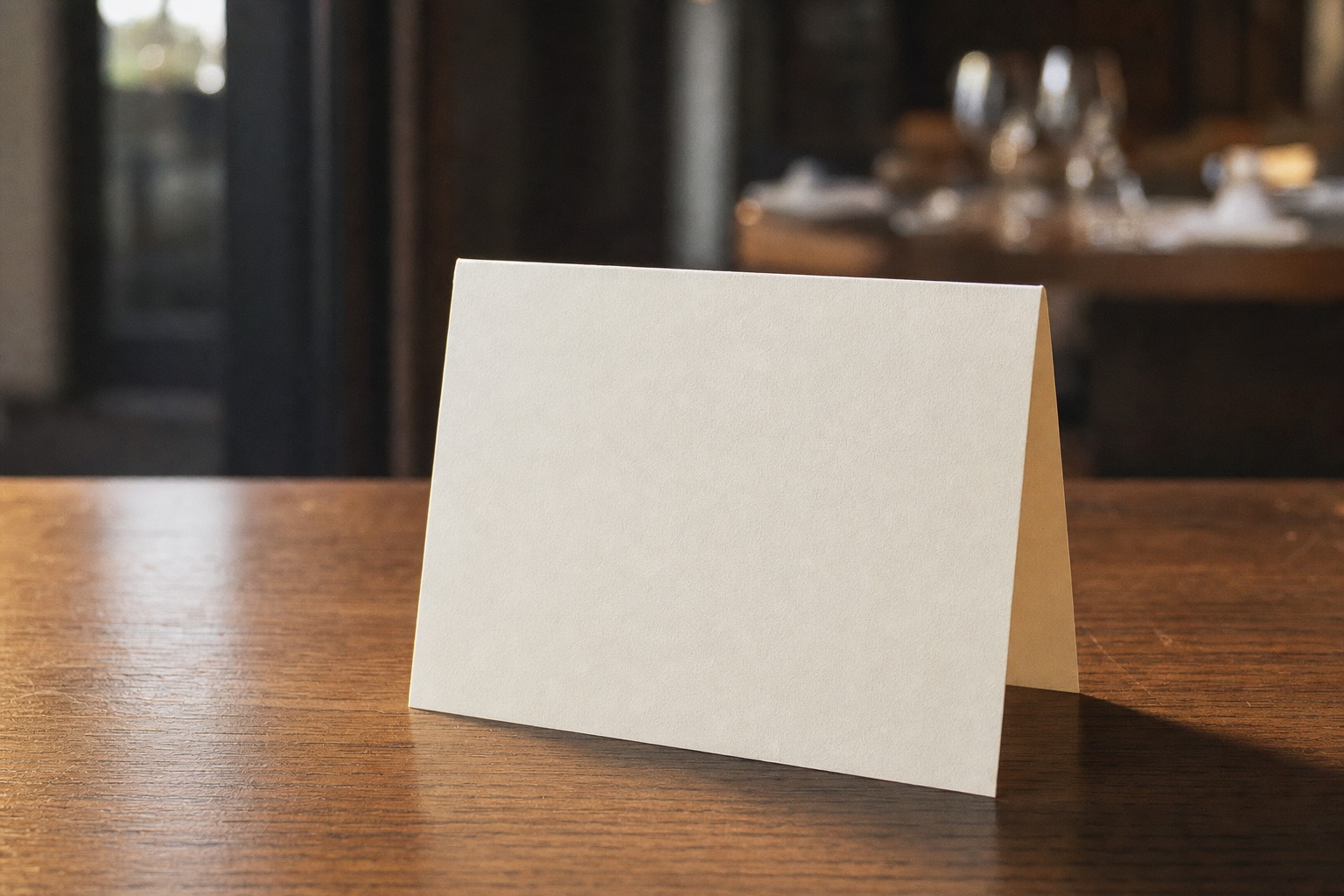
Tent cards are folded, self-standing printed cards placed on tables, counters, shelves, or other flat surfaces. They present short messages such as promotions, menu items, prices, place names, instructions, or directions at the point where someone needs the information.
A finished card usually has two upright panels joined at a fold. Depending on its construction, the bottom may remain open in an inverted V shape or use tabs and additional folds to create a more stable triangular base.
Because the display stands without a separate holder, it is easy to position, move, replace, and pack for distribution. That makes tent cards useful in restaurants, hotels, conferences, weddings, showrooms, service counters, and retail stores.
For retailers, a tent card is a compact point-of-purchase display. It can promote a seasonal offer, explain a product benefit, provide a QR code, or guide customers through a checkout or pickup process without taking up much counter space.
How do tent cards work?
A tent card works by turning a flat printed sheet into a freestanding display through scoring and folding. Its two visible panels carry the message, while the folded structure provides enough rigidity to keep the piece upright.
The simplest format uses one central fold. A university template, for example, defines table tent cards as a standard 8.5 × 11-inch sheet folded in half. Other designs add a base panel, interlocking tabs, adhesive, perforated sections, or die-cut slots for better stability or easier assembly.
Many tent cards print the same message on both outward-facing panels. This allows customers approaching from either direction to see the offer. Another option is to use each side differently, such as a product promotion on one panel and instructions or a QR code on the other.
Correct panel orientation is important. Since one panel may be upside down on the flat press sheet, artwork should be prepared using the printer’s dieline or folding template rather than assembled as two ordinary pages.
Where are tent cards used?
Table tent cards are used wherever a small, movable display needs to communicate at close range. Their strongest applications are tabletop service, point-of-sale promotion, customer guidance, seating identification, and localized merchandising.
Retail stores and service counters
At checkout counters, these displays can feature loyalty programs, financing options, warranties, gift cards, or limited-time offers. On product tables, they can identify featured items or explain details that may not fit on packaging.
They are also practical for store operations. A retailer can use them to mark pickup areas, provide return instructions, identify demonstration products, or direct customers to another department.
Restaurants, cafés, and hospitality
Restaurants use table tent cards for daily specials, desserts, beverages, QR-based ordering, and upcoming events. They can be coordinated with professionally printed restaurant menus & tabletop materials so that colour, typography, pricing, and promotions remain consistent across the guest experience.
Hotels and venues may use them for breakfast information, Wi-Fi instructions, reserved seating, room identification, or sponsor recognition.
Trade shows, meetings, weddings, and events
Freestanding place cards can identify speakers, attendees, table numbers, sponsors, or agenda items. At receptions and formal dinners, they may serve as name cards that help guests find their assigned seats while complementing the table setting.
Variable digital printing makes it possible to personalize each piece with a different name or message without producing separate plates. This is useful for conferences as well as weddings where every guest or table may require unique information.
For event use, designers should consider viewing distance. Name cards seen from across a meeting table need larger type than place cards intended to be read by someone standing directly in front of a seat.
What sizes and formats are available?
Table tent cards do not have one universal size. Their finished dimensions should reflect the available surface, viewing distance, content volume, and packaging requirements for distribution.
A letter-size sheet folded in half is convenient for office or short-run applications because it works with a familiar page size. Commercially printed displays can be produced in many other dimensions, including common 5 × 7-inch and 4 × 6-inch formats.
Size affects more than visibility. A larger card may communicate more information, but it occupies more counter space and may require heavier stock or a stronger base. A smaller card is easier to distribute across many locations, but it demands more disciplined copy and typography.
Before choosing dimensions, confirm:
- Where the card will sit
- How far away it must be readable
- Whether people will see one side or both
- How many cards each location needs
- Whether it will ship flat or pre-folded
- Whether it must fit into an existing promotional kit
- Whether store staff will need assembly instructions
For chain-wide campaigns, the packed dimensions can be as important as the finished size. A design that ships flat can reduce bulk and make store-level allocation easier.
How should table tent artwork be designed?
Artwork should be built around the final folds, trim lines, safe area, and viewing direction. The key message must remain clear after the flat sheet becomes a standing display.
Build from the printer’s template
Use the supplied dieline whenever possible. It should identify the trim, folds, panel boundaries, tabs, perforated areas, and any sections hidden by assembly.
Some print instructions specify a 0.125-inch bleed and a 0.125-inch safe area. Exact requirements vary by job, so the production template should always take priority.
Background colours and images should extend through the bleed. Logos, prices, QR codes, and important text should stay inside the safe area and away from folds.
Printable table tent cards intended for in-house production may be compatible with both laser and inkjet printers. Compatibility depends on the card stock, coating, sheet size, perforations, and the printer’s paper-weight limits, so the material and equipment specifications should be checked before printing a full run.
Keep the message focused
These cards are usually read quickly. A practical content hierarchy is:
- A short headline
- One central offer or instruction
- A supporting detail, price, or date
- A clear call to action or QR code
- Essential conditions in readable type
Trying to reproduce an entire flyer on a small display often produces cramped text. For retail promotion, the card should communicate one reason to stop, look, scan, or ask.
Place cards require a different hierarchy. The guest’s name or table number should be the most prominent detail, with decorative elements kept from interfering with legibility.
Prepare images and colours for print
Print artwork commonly uses CMYK colour and 300 PPI images at their final placed size. Low-resolution web graphics may appear soft or pixelated when printed.
For colour-critical retail programs, provide brand colour references and request an appropriate proof. Screen previews do not perfectly represent printed colour, particularly on uncoated, coloured, or highly absorbent stocks.
Printable designs produced on office equipment may use different colour settings than files prepared for a commercial press. The printer’s template and file specifications should determine the correct setup.
Which paper and finishing options work best?
Freestanding cards generally need cover stock rather than lightweight text paper because the material must stand upright and tolerate handling. The ideal stock and finish vary according to card size, structure, environment, campaign length, and desired appearance.
One published product specification uses 12 pt gloss-coated cover, but this is an example rather than a universal requirement. A printer may recommend another thickness based on the design and expected use.
Common choices include:
- Coated cover: Produces crisp colour and photographs for promotions.
- Uncoated cover: Offers a tactile, understated appearance and can be easier to write on.
- Matte or gloss lamination: Adds surface protection and changes the visual finish.
- Protective coating: Helps printed pieces resist scuffing during packing and handling.
- Foil or embossing: Adds emphasis for premium hospitality, beauty, or launch campaigns.
- Die-cutting: Creates custom shapes, tabs, windows, or interlocking structures.
- Scoring: Forms a controlled fold and reduces cracking on heavier stocks.
- Perforation: Makes sections easier to detach or helps sheets separate cleanly before folding.
Scoring is especially important when folding thick cover or printing heavy colour across the fold. Paper grain direction, ink coverage, and coating can all influence fold quality, so the physical construction should be reviewed before production.
What matters in a multi-location retail rollout?
For a multi-store rollout, tent cards must be easy to sort, ship, assemble, place, and remove. Production planning should address the full program rather than treating every card as an isolated printed piece.
Digital printing may suit shorter runs, regional versions, or variable store information. Offset printing may be appropriate for larger quantities with shared artwork. The best method varies by run length, version count, colour requirements, stock, finishing, and schedule.
A store-ready program can include:
- Quantities allocated by location
- Bilingual English and French versions
- Province-specific offers or conditions
- Store numbers printed on package labels
- Flat-packed or pre-assembled cards
- Placement diagrams and assembly instructions
- Coordinated shelf signs, decals, danglers, or counter displays
- Master-carton labels for distribution centres
In Quebec, language and version control should be addressed during artwork planning, not after printing. Bilingual copy can affect type size, panel balance, and the amount of space required, particularly on compact cards.
Frequently asked questions about table tent cards
Buyers usually need to confirm size, stock, print coverage, assembly, and artwork requirements before ordering. These answers cover the most common production questions.
Are tent cards the same as table tents?
The terms are often used interchangeably. “Table tent” usually emphasizes use on dining or meeting tables, while “tent card” can also describe countertop, retail, event, and directional displays.
Are they the same as place cards?
Not always. Place cards primarily identify where an individual guest should sit, while a table tent may present a promotion, menu, schedule, table number, or general information. However, folded place cards and name cards often use the same self-standing construction.
Can tent cards be printed on both sides?
Yes. Both outward-facing panels can carry the same message or different content. Confirm panel orientation using the printer’s template so each side reads correctly after folding.
Do tent cards arrive folded?
They can be supplied flat, scored and ready to fold, or assembled, depending on the structure and fulfilment plan. Flat delivery is often practical for large store rollouts, while pre-assembly can save time at the destination.
What file format should be supplied?
A print-ready PDF is commonly requested, with fonts embedded or outlined and artwork prepared to the supplied dieline. Bleed, safe areas, colour mode, and image resolution should be confirmed with the printer.
Can every card include different information?
Yes. Digital printing can personalize names, table numbers, store addresses, QR codes, offers, or regional messages. Variable data must be organized carefully and matched to the correct packing list.
How long do table tents last?
Service life varies by stock, coating, handling, moisture, sunlight, and location. A short promotional campaign may need only coated cover stock, while frequently handled or longer-term displays may benefit from lamination or another protective finish.
Request a quote
Have a print or packaging project? Talk to our team. We take it from concept to delivery, on our own presses, here in Montreal.