
What is reliure allemande?
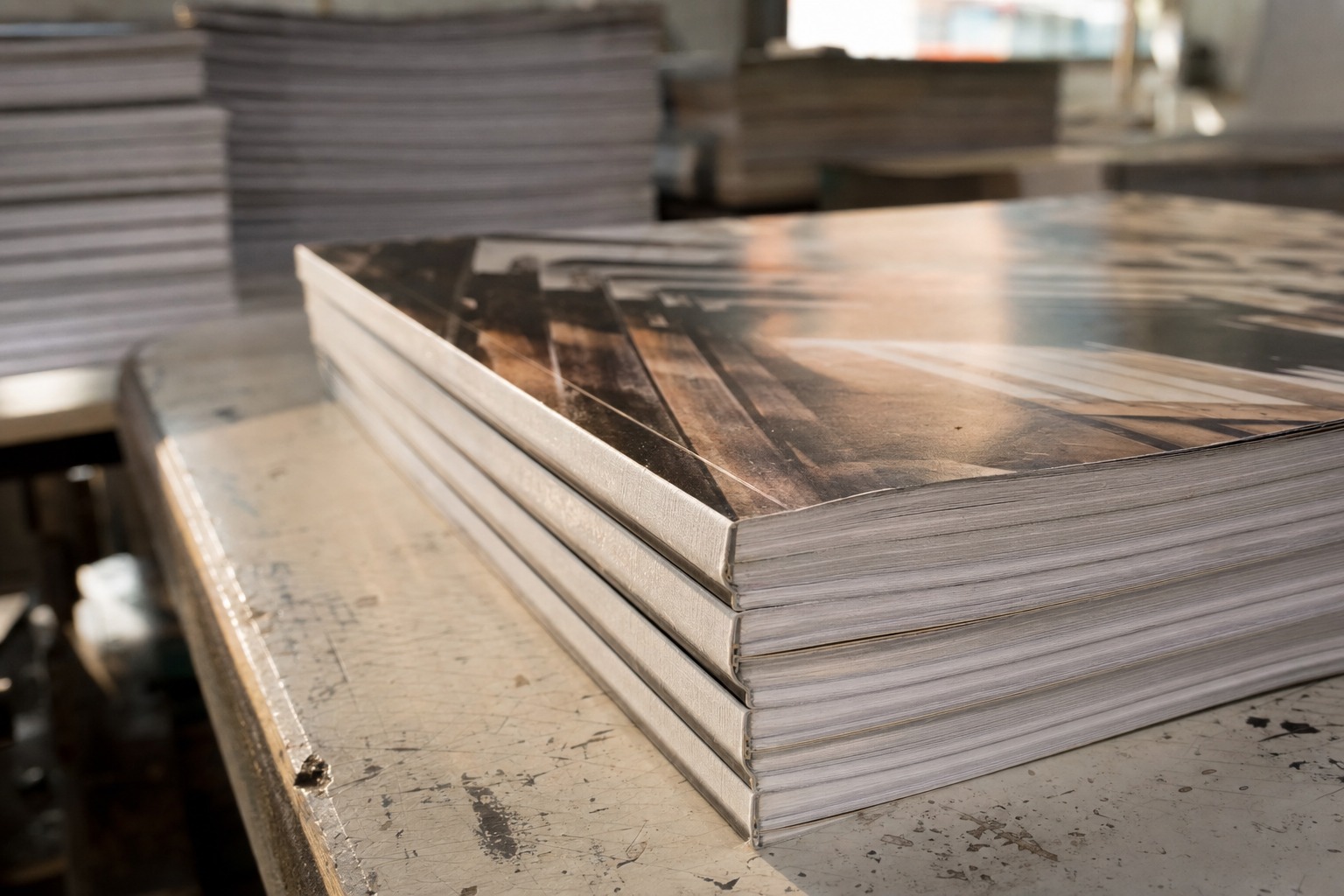
Reliure allemande is a square-spine glued binding commonly called perfect binding or dos carré collé. The pages are secured at the spine and enclosed in a wraparound cover, creating the clean, printable spine associated with books, catalogues and substantial retail publications.
In Quebec and other French-speaking markets, several terms may appear on estimates and production files:
- Reliure allemande
- Dos carré collé
- Perfect binding
- Thermoreliure
These terms are sometimes used interchangeably, but they do not always describe precisely the same construction. Thermoreliure, for example, broadly refers to heat-activated binding and may include simpler document-binding systems. A buyer should confirm that the estimate specifies a professionally trimmed, square-spine product rather than relying on terminology alone.
A French-language binding guide describes reliure allemande as pages assembled by gluing, with a square spine and a soft or hard cover (Les Éditions Anonymes binding guide, 2020). In commercial printing, the most common version uses a flexible, one-piece cover wrapped around the bound text block.
The name has historical connections to German book production and trade organization. The German book-trade association in Leipzig dates to 1884, reflecting the country’s long relationship with formalized publishing and binding crafts (Bibliopat resource, 2015).
Core specifications to confirm
The essential specifications are the finished size, page count, text paper, cover stock, spine width and binding adhesive. These elements must be evaluated together because changing the paper or page count can alter the spine and cover file.
Finished size and orientation
Reliure allemande can accommodate many portrait, landscape and square formats, but machine limits vary. An unusually narrow spine, short binding edge or oversized landscape format may require a different production method.
The binding edge should be identified clearly when requesting an estimate. This is especially important for landscape catalogues and manuals, where binding on the short or long edge produces very different results.
Page count
The practical page range varies by paper thickness, finished format, adhesive and binding equipment. Thin publications may not provide enough spine area for reliable gluing or readable spine text, while very thick books can become difficult to open and handle.
Page counts are generally planned as an even total because each leaf has a front and back. Offset-printed signatures can create additional pagination requirements, so the printer should verify the imposition before the design is finalized.
Text and cover paper
Grammage alone does not determine whether a stock is suitable. Two papers with the same basis weight can have different calipers, coatings, fibres and folding behaviour.
Common decisions include:
- Coated text paper for photography, product catalogues and colour-rich lookbooks
- Uncoated paper for books, workbooks and publications that need a softer reading surface
- Opaque paper when show-through would interfere with charts or dense copy
- Heavier cover stock for protection and a more substantial feel
- A scored cover when the stock requires controlled folding around the spine
The paper must also accept the chosen adhesive. Highly coated, laminated or digitally printed surfaces can require specific preparation and glue chemistry.
Spine width
Spine width should be calculated from the selected production stock, not estimated from grammage or from a previous project. A common prepress formula divides the page count by 2 to determine the number of leaves, then multiplies that total by the paper’s measured thickness (technical specification, 2024 edition).
In simplified form:
Spine width = number of pages ÷ 2 × paper caliper
The printer may adjust the result for production tolerances, adhesive and cover construction. Designers should therefore request the confirmed spine dimension before building the final wraparound cover.
Cover, adhesive and finishing options
Reliure allemande can be adapted through paper, coating, lamination and decorative finishing. The best combination depends on how the publication will be transported, displayed and handled.
Cover treatments
A cover may be left uncoated or protected with varnish, aqueous coating or lamination. Lamination is often considered for retail catalogues, field manuals and books that will be handled repeatedly.
Matte finishes reduce glare and create a restrained appearance. Gloss finishes strengthen colour and are easy to wipe. Soft-touch films produce a tactile surface but should be tested for scuffing, fingerprints and compatibility with foil or other embellishments.
Adhesive choices
EVA and PUR are two adhesives commonly associated with commercial perfect binding. The right choice depends on the paper, ink coverage, coating, page count, expected use and production equipment.
PUR is often considered for demanding stocks or publications that will receive repeated handling. However, adhesive selection should be based on the complete specification rather than treated as an automatic upgrade. Good spine preparation and a paper-compatible glue are fundamental to binding strength.
Decorative and functional finishing
The cover can include:
- Foil stamping
- Embossing or debossing
- Die-cut windows
- Spot coating
- Matte or gloss lamination
- Fold-out cover panels
- Perforated forms or detachable sections
- Drilled holes or other application-specific features
Each addition should be reviewed for its proximity to the spine, folds and trim. Heavy ink, foil or raised elements directly across a score can crack or distort if the materials are not tested.
Best uses for reliure allemande
Reliure allemande is best suited to multi-page publications that need a professional square spine, generous printable cover area and efficient production. Typical applications include catalogues, magazines, annual reports, books, training manuals and retail selling tools.
For retail programs, it works particularly well for seasonal product books, dealer catalogues, visual merchandising guides and staff training publications. A printed spine makes titles easier to identify when several editions are stored or displayed together.
Accent Impression produces catalogues, journals and other bound pieces through its dedicated magazines & publications service, including production for multi-location retail programs.
Other suitable uses include:
- Brand lookbooks and buyer presentations
- Product specification catalogues
- Franchise and store operations manuals
- Educational workbooks
- Conference programs
- Corporate reports
- Short-run books
- Membership and association publications
A thick promotional brochure does not automatically need reliure allemande. Saddle stitching may be simpler for a slim piece, while coil binding can be better for a manual that must remain open on a counter.
Advantages and trade-offs
The main advantages are a printable square spine, a polished book-like appearance and suitability for substantial page counts. The main trade-offs are restricted lay-flat behaviour, critical spine calculations and some loss of visible area near the binding edge.
Where it performs well
The flat spine provides room for a title, issue number, logo or product category. The wraparound cover also creates one continuous design surface across the back, spine and front.
Reliure allemande can support short or long production runs, depending on the printing and binding equipment. Digital printing may suit targeted editions or frequent updates, while offset printing may suit larger quantities and colour-critical publications. The economical crossover point varies by job.
Where another binding may be better
A perfect-bound book does not normally lie completely flat without pressure. This matters for recipes, technical instructions, workbooks and manuals used hands-free.
Images and text crossing two facing pages can also lose content in the gutter. Designers should allow a generous inside margin and avoid placing faces, small type or critical product details directly across the centre.
For a low-page-count publication, saddle stitching may open more easily and avoid an excessively narrow spine. For a manual used at a retail service desk or production station, coil or Wire-O binding may provide better usability.
How to make the buying decision
Choose reliure allemande when the square spine, page capacity and book-like presentation improve the publication’s function. Compare it with saddle stitching and mechanical binding based on page count, handling, distribution and reader behaviour.
Before requesting pricing, establish:
- Finished dimensions and binding edge
- Final or estimated page count
- Text and cover stock preferences
- Print quantity and number of versions
- Mailing, carton packing or store-kitting requirements
- Required durability and expected service life
- Cover coatings or decorative finishes
- Delivery schedule and rollout locations
For a national retail rollout, version control can be as important as binding. Language, region, banner, store format and promotional period may each require a different cover or interior. The production plan should identify these versions before printing, binding and kitting begin.
A physical dummy is useful when paper bulk, opening behaviour or mailing weight affects the decision. It can reveal that a proposed book is too stiff, too thick for its intended holder, or difficult to use on the sales floor.
Preparing reliable artwork
Reliure allemande artwork normally includes a separate interior file and a one-piece cover file. The cover should not be finalized until the printer supplies or approves the spine width.
The cover layout typically contains the back cover, spine and front cover in one spread. It must include the required bleed, trim and fold or score positions.
Key prepress checks include:
- Keep spine text centred with adequate clearance
- Respect safe zones around spine folds and trim
- Allow sufficient inside margin on interior pages
- Avoid critical content across facing-page gutters
- Include blank pages in the final page count
- Verify barcode size, contrast and placement
- Confirm whether the inside covers will be printed
- Supply fonts, images and colour settings as requested
Do not create spine text before the stock is confirmed. Even a modest paper change can shift the spine folds enough to make text appear off-centre.
Frequently asked questions about reliure allemande
Reliure allemande is straightforward once the paper, pagination and spine are coordinated. The following questions address the production details buyers most often need to confirm.
Is reliure allemande the same as perfect binding?
Usually, yes. In Quebec printing terminology, reliure allemande and dos carré collé commonly refer to perfect binding. Because terminology can vary, the estimate should still confirm a glued text block, square spine and wraparound cover.
What is the minimum page count?
There is no universal minimum. It varies according to paper thickness, book format, cover construction and binding equipment. A thin project may be better suited to saddle stitching, so the printer should review the complete specification.
Can a perfect-bound book lie flat?
Not in the same way as a coil-bound or specially engineered lay-flat book. It can be opened comfortably, but content close to the gutter may be harder to see. Wider inside margins improve readability.
Can text be printed on the spine?
Yes, provided the spine is wide enough for legible type and safe production tolerances. Very thin spines may not support a title, logo or issue number reliably.
Is coated paper suitable?
Yes, many coated papers can be perfect bound. The paper, coating, ink coverage and adhesive must be compatible, especially for heavily printed catalogues or laminated components.
When should the cover file be created?
The design can begin early, but the final cover width should wait until the printer confirms the paper, page count and spine measurement. Using a generic spine estimate can lead to misplaced folds and off-centre artwork.
Request a quote
Have a print or packaging project? Talk to our team. We take it from concept to delivery, on our own presses, here in Montreal.