
What are shelf talkers?
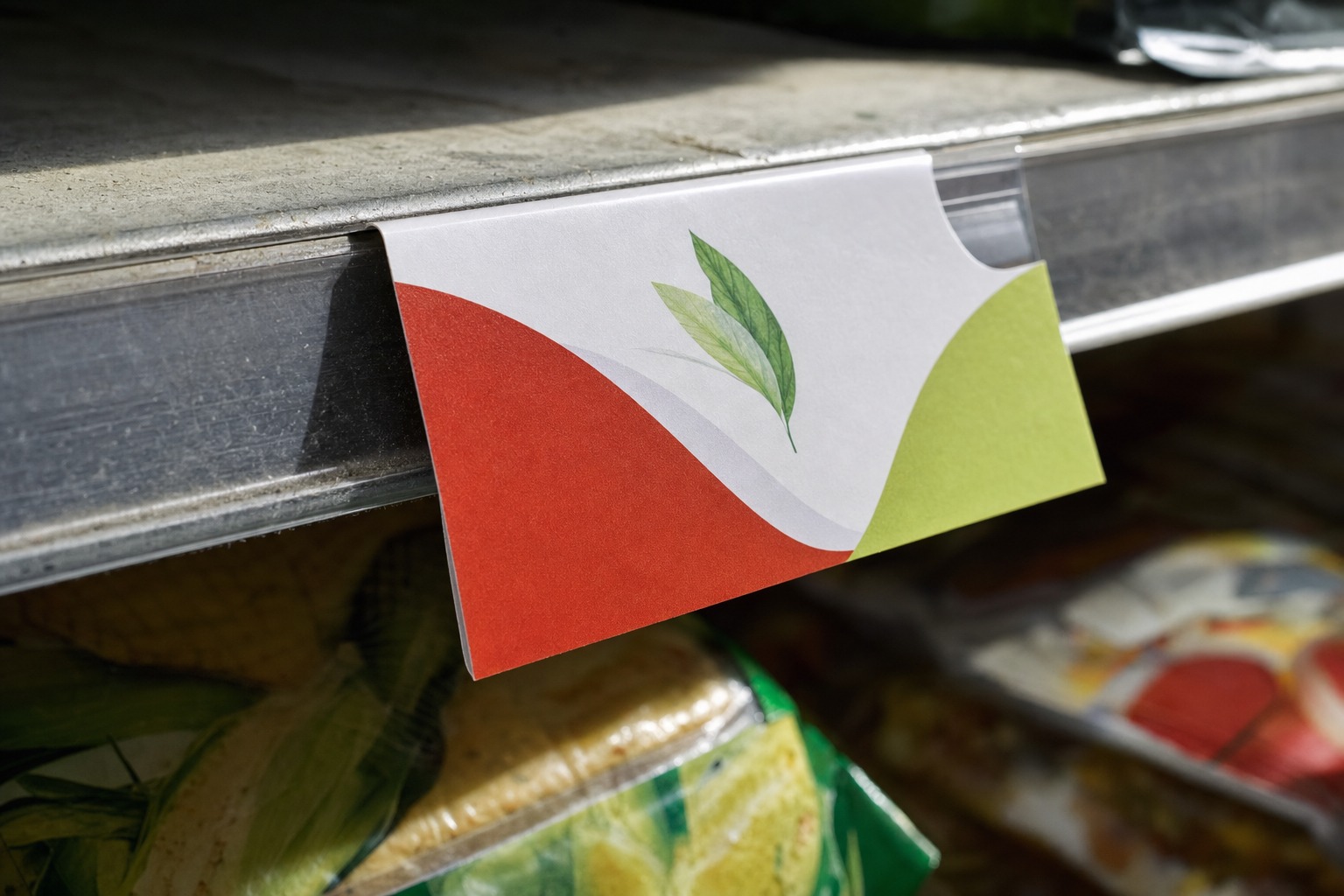
Shelf talkers are compact printed signs attached to or projecting from a shelf edge. Retailers use them to draw attention to a product, price, promotion, feature or category message at the point of purchase.
The September 2024 IAB and IAB Europe standards classify the shelf talker as a printed or static advertising format within in-store retail media (IAB and IAB Europe, 2024). This distinction matters because shelf talkers can be planned as measurable campaign assets rather than treated as miscellaneous retail signage.
Placed a few centimetres from the product, a shelf talker interrupts the visual rhythm of a stocked shelf. It can support:
- Temporary price promotions
- New-product launches
- Product benefits and comparisons
- Loyalty offers
- Local or Canadian product identification
- Sustainability, ingredient or certification messages
- QR codes connecting shoppers to digital content
- Cross-merchandising recommendations
- Sponsored retail media campaigns
By highlighting a relevant offer at the point of decision, a shelf talker can strengthen product promotion and encourage an impulse purchase. Related formats include shelf wobblers, retail danglers, aisle flags and shelf strips. Their construction and placement differ, but all are intended to make a message more visible within a busy retail environment.
Unlike a shelf label, which usually communicates essential price and product information, a shelf talker is primarily promotional. The two can sit together, but the design must not obscure pricing, barcodes, electronic shelf labels or information inside the price rail.
Which shelf-talker specifications must be defined?
A complete shelf-talker specification should identify the finished size, material, printing, attachment method, finishing and packing requirements. There is no universal shelf-talker size or construction that works across every retailer and shelving system.
Finished size and shape
Start by measuring the available shelf-edge area and the permitted projection into the aisle. Retailers may have strict merchandising guidelines governing width, height, shape and placement.
The finished size should provide enough room for the headline, offer, brand and any mandatory details without overwhelming nearby products. A large piece can attract attention, but it can also block packaging, interfere with restocking or become damaged by carts and customers.
Common shapes include:
- Rectangles and squares
- Circles or rounded tabs
- Arrows
- Product silhouettes
- Folded flags
- Die-cut shapes based on campaign artwork
A custom die-cut shape can improve recognition, especially for a launch or branded promotion. Simple shapes are generally easier to produce, pack and install at scale.
Flat, folded or projecting construction
A flat shelf talker sits against the shelf edge, price rail or sign holder. A projecting format extends into the aisle, giving the message more visibility from the shopper’s direction of travel. Shelf wobblers use a flexible arm or strip that lets the printed panel move slightly, while retail danglers typically hang below or in front of the shelf edge.
Folded designs can combine several functions. One panel carries the message while another forms an attachment tab. The printer needs a dieline that clearly marks cuts, folds, adhesive zones and the intended viewing direction.
Artwork and safe areas
Important content should remain inside a safe area, away from die-cut edges, folds and attachment points. Artwork normally requires bleed when colour or imagery runs to the trimmed edge.
Retail buyers should also confirm whether the store needs:
- English, French or bilingual versions
- Regional prices or offers
- Unique store numbers
- Product-specific barcodes
- QR codes or promotional codes
- Campaign start and removal dates
For Quebec programs, bilingual planning should begin before the layout is finalized. French and English copy often require different amounts of space, so direct substitution in a fixed design can create readability problems.
What materials are available for shelf talkers?
Shelf talkers can be produced from coated paper, cardstock, synthetic stock, PVC or pressure-sensitive label material. The right choice depends on campaign duration, store conditions, attachment method and required stiffness.
Paper and cardstock
Coated paper or cardstock is a practical choice for short-term indoor promotions. It prints well, supports precise brand colour and can be scored, folded, laminated or die-cut.
Stock weight should be selected with the finished structure in mind. A flat insert held inside a rail may need less stiffness than a projecting talker expected to remain straight for several weeks. Heavier is not automatically better because excessive thickness can make folding or insertion difficult.
Synthetic and moisture-resistant stocks
Synthetic materials may suit grocery, refrigerated, garden-centre or high-contact environments. Options can include polypropylene, polyester and certain PVC constructions. They generally offer better resistance to moisture and tearing than ordinary paper, although performance varies by product.
The printer should be told about cold temperatures, condensation, sunlight, cleaning routines and expected campaign length. “Water-resistant” and “waterproof” are not interchangeable specifications. Material thickness and flexibility also matter because a rigid PVC piece may behave differently from a thin synthetic shelf strip or flexible wobbler arm.
Pressure-sensitive label constructions
Adhesive shelf talkers can use a facestock, adhesive layer and release liner. One published label specification uses direct-thermal clear polypropylene, permanent acrylic adhesive and a 40 lb paper liner (manufacturer specification).
That construction illustrates why buyers should specify the entire material system, not simply ask for “a sticker.” The facestock affects appearance and durability, while the adhesive determines whether the piece stays attached and whether it can later be removed cleanly.
How should shelf talkers attach to the shelf?
The attachment should fit the retailer’s shelf system, remain secure for the campaign and allow efficient removal. Adhesive tabs, clips, channels, sign holders, snap-in components and folded locking tabs are all possible options.
Adhesive-backed formats
Pressure-sensitive adhesive provides a clean installation when the shelf surface is compatible and properly prepared. Permanent adhesive offers stronger holding power, while removable adhesive can be more appropriate for temporary campaigns.
Adhesive performance changes with surface energy, dust, cleaning residue, application pressure and temperature. One published shelf-talker label specification reports an operating range of -85°F to 140°F (-65°C to 60°C) and a five-minute dwell adhesion value of 14 oz/in (manufacturer specification). These are product-specific test values, not universal performance guarantees.
Another adhesive-backed construction lists a tape thickness of 4.1 mil and adhesion-to-steel test values of 65 on both liner-side and air-side measurements (product datasheet). Buyers should have the printer confirm whether a proposed adhesive suits the actual shelf material.
Clips, rails and sign holders
Mechanical attachments are useful when stores prohibit adhesive or reuse the same hardware for multiple campaigns. Options include:
- Shelf-edge clips
- Adhesive or magnetic sign holders
- Price-rail and data-strip inserts
- Shelf wobblers
- Hinged arms
- Snap-in tabs for compatible channels
- Folded tabs that lock into shelf channels
Aisle flags may use similar clips or hinged fittings but usually project farther from the shelf to present a message perpendicular to shopper traffic. Retailers should provide a sample shelf rail, holder or clip whenever possible. A physical fit test is more reliable than designing from a photograph.
Accent Impression produces shelf talkers as part of coordinated POP / POS displays programs, including kitting for multi-store retail rollouts across Canada.
Which printing and finishing options make sense?
Printing and finishing should support the campaign objective without making installation unnecessarily complex. Colour accuracy, durability and version control are usually more important than decorative effects alone.
Offset or digital printing
Offset printing is well suited to larger quantities, standardized artwork and colour-critical programs. Digital printing is useful for shorter runs, fast version changes and variable content by store, region or product.
The best custom printing method varies by quantity, dimensions, material, number of versions and turnaround. A campaign with one national design may require a different approach from a rollout containing hundreds of store-specific price files.
Finishing choices
Useful finishing options include:
- Die-cutting for custom shapes
- Scoring and folding for projecting formats
- Lamination for added surface protection
- Spot varnish for visual contrast
- Foil or embossing for premium launches
- Rounded corners to reduce snagging
- Perforations for tear-off coupons
- Sequential numbering for campaign control
Finishing must not compromise function. A heavy laminate can change fold behaviour, while foil placed near a score may crack or distort. Production samples help confirm the result.
How should buyers plan a retail rollout?
A successful rollout requires accurate quantities, store-level versioning, installation instructions and clearly labelled kits. Printing is only one part of getting the correct shelf talkers into the correct locations on schedule.
Begin with a distribution list showing stores, quantities, languages and campaign versions. Include extra pieces where store damage or last-minute placement changes are likely, but determine overage according to the actual program rather than applying an assumed percentage.
For national or multi-banner campaigns, consider:
- Packing by store, region or retail banner
- Bundling talkers in installation order
- Identifying each version on the reverse
- Including placement maps or planograms
- Protecting projecting tabs during shipping
- Separating hardware from printed pieces
- Tracking cartons and delivery status
- Planning retrieval or recycling after the campaign
A prototype should be tested on the real shelf before full production. Check visibility from several angles, attachment strength, interference with products and how easily store staff can install it. For shelf wobblers and other projecting pieces, confirm that movement does not cover neighbouring labels or create an obstruction.
How do you choose the right shelf talker?
Choose shelf talkers by working backward from the shelf environment, campaign duration and store installation process. The best option is the one that remains readable, secure and easy to deploy across every participating location.
Before requesting pricing, provide the printer with:
- Finished dimensions and preferred shape
- Total quantity and number of versions
- Retailer or banner guidelines
- Shelf photographs and measurements
- Required material or durability
- Attachment preference
- Printing and finishing details
- Language and regional requirements
- Store-level packing information
- Delivery destinations and deadline
If specifications are still open, share the campaign objective and a sample of the shelf hardware. A printer can then recommend a construction and prototype for testing.
Frequently asked questions about shelf talkers
Shelf-talker buyers most often ask about sizing, materials, adhesives, artwork and rollout quantities. These decisions depend on the store fixture and campaign rather than on a single industry standard.
Is there a standard shelf-talker size?
No. Dimensions vary by retailer, shelf system, product category and desired visibility. Measure the fixture and confirm the retailer’s merchandising rules before finalizing artwork.
What is the difference between shelf talkers and shelf wobblers?
A shelf talker is a broad category of promotional signage attached at the shelf edge. A shelf wobbler is a projecting type that uses a flexible strip or arm, allowing the printed panel to move and attract attention as shoppers pass.
Should shelf talkers use cardstock or synthetic material?
Cardstock is often suitable for short indoor campaigns. Synthetic material may be preferable where moisture, tearing, cold conditions or frequent handling are concerns.
Can shelf talkers be printed with different prices for every store?
Yes. Digital printing and variable-data workflows can support store-specific prices, languages, product details, QR codes and identifiers. Clean, validated data is essential.
Are removable adhesives guaranteed not to leave residue?
No adhesive performs identically on every surface. Shelf coating, age, temperature, cleaning products and campaign duration can affect removal, so test the proposed material on the actual fixture.
How much information should a shelf talker contain?
Use one primary message that can be understood quickly. A short headline, clear benefit or offer, strong product cue and necessary conditions will usually perform better than a dense block of copy.
What should be tested before ordering the full quantity?
Test size, readability, colour, folding, attachment, shelf fit and removal. The prototype should also be packed and handled as the final pieces will be, particularly when projecting tabs or clips could be damaged in transit.
Request a quote
Have a print or packaging project? Talk to our team. We take it from concept to delivery, on our own presses, here in Montreal.