
What a Full-Service Montreal Direct Mail Printer Handles
A full-service direct mail printer manages the complete job, from artwork and data preparation through printing, personalization, inserting, postal preparation and mailing. This integrated approach gives buyers one production schedule, one set of specifications and clearer accountability.
When evaluating an imprimeur courrier direct Montreal service complet impression et envoi, confirm that the quoted service covers more than printing. In French-language estimates, direct mail may also be described as publipostage, while postal preparation may appear as préparation postale. Whatever terminology is used, a complete program may include:
- Format and paper recommendations
- Prepress review and proofing
- Offset or digital printing
- Variable-data printing
- Folding, cutting and finishing
- Envelope printing and addressing
- Automated or manual inserting
- List processing and deduplication
- Postal sorting and documentation
- Delivery to the appropriate postal facility
- Production reporting and leftover inventory management
The exact workflow depends on the piece. A simple postcard requires printing, trimming, addressing and postal preparation. A personalized package containing a letter, reply card and brochure requires more extensive data controls, matching and insertion. An imprimeur offering a true service complet should identify who is responsible for each stage, including the final envoi.
Direct Mail Formats and Specifications
The right direct mail format balances message space, production cost, postal requirements and ease of handling. Dimensions, thickness, weight, paper construction and enclosure count can all affect whether an item qualifies for automated processing.
Postcards and Self-Mailers
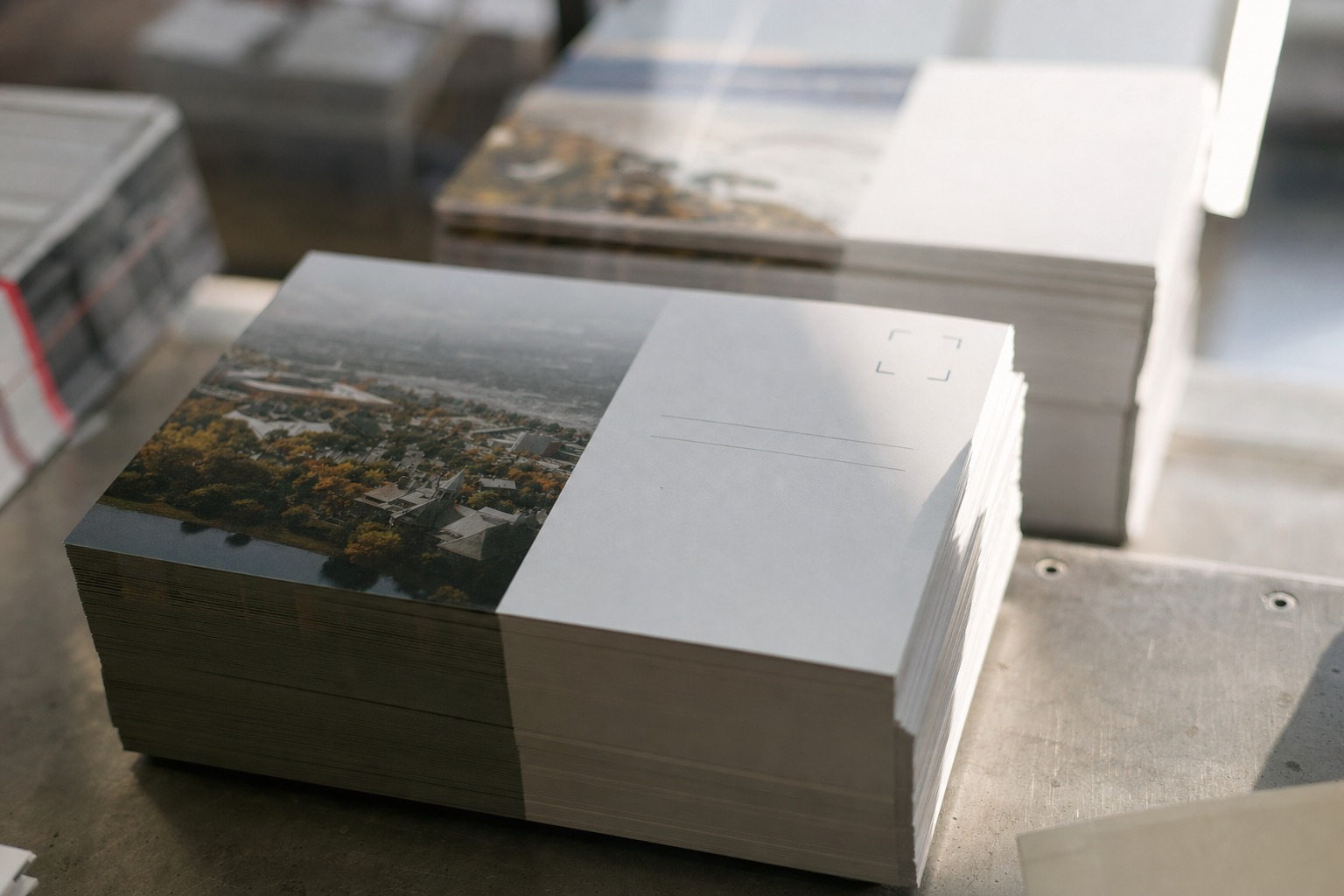
Postcards, or cartes postales, are well suited to short offers, event announcements, store openings and local acquisition campaigns. Because recipients see the message immediately, the headline, offer and call to action need to work without an envelope.
Self-mailers provide more room by folding a printed sheet into a compact mailing piece. Depending on the design and postal requirements, tabs or another closure method may be necessary. These pieces, including folded dépliants, are useful for product launches, loyalty offers, seasonal promotions and service reminders.
Before approving the design, the printer should verify:
- Finished width and height
- Fold direction and panel sequence
- Final thickness and rigidity
- Address-panel location
- Clear zones for postal markings
- Closure requirements
- Coating or finish on the addressing area
Letters and Envelope Packages
An envelope package can contain a personalized letter, brochure, coupon, reply device or additional insert. It works well when the message needs explanation, privacy or a more formal presentation.
Common buying decisions include envelope size, window versus closed-face construction, the number of inserts and whether components will be inserted mechanically or by hand. Each component must be designed as part of the same production system. A brochure that is slightly too large or a fold that varies can slow insertion and increase handling.
For a campagne adressée, the envelope, letter and response device may also carry matching identifiers. These controls help prevent one recipient’s personalized material from being inserted into another recipient’s envelope.
Catalogues, Brochures and Dimensional Mail
Catalogues and multi-page brochures support larger product ranges and information-heavy campaigns. Binding options may include saddle stitching, perfect binding or another method selected according to page count and paper.
Dimensional mail includes samples, promotional products or unusually shaped packages. It can attract attention, but non-standard construction may require special handling and different postal preparation. Buyers should request a physical production test before committing to a large quantity.
All formats should be checked against current Canada Post requirements. Postal categories and preparation rules may change, and compliance varies by finished piece rather than artwork size alone. The imprimeur or mailing provider should validate the intended construction before the final artwork and impression are approved.
Printing, Paper and Finishing Options
Digital printing is generally suited to shorter runs, fast version changes and high levels of personalization, while offset printing is often considered for longer quantities and consistent production across many pieces. The best process varies by run length, format, colour requirements, schedule and variable content.
Choosing Between Digital and Offset Printing
Digital production, commonly described as impression numérique, can change names, text, images, barcodes or offers from one recipient to the next. It also supports smaller geographic batches, which can be useful when testing creative concepts or mailing to selected neighbourhoods.
Offset printing is appropriate when a campaign requires substantial quantities, specific spot colours or efficient production of a common static design. A hybrid workflow is also possible. For example, a shell can be printed offset and later personalized through impression numérique.
Ask the printer to compare the total program cost rather than the press cost alone. Data work, finishing, insertion, spoilage, postal preparation and freight between suppliers can materially affect the final budget. A quote for impression alone may therefore be lower without representing the actual cost of the complete mailing.
Paper Selection
Paper influences colour, readability, opacity, stiffness and machine handling. Typical choices include coated stocks for image-heavy pieces, uncoated papers for a tactile or letter-like appearance, and heavier cover stocks for postcards.
Important characteristics include:
- Basis weight or grammage
- Caliper and rigidity
- Opacity, especially for double-sided letters
- Surface compatibility with personalization equipment
- Fold and scoring performance
- Recycled content or other environmental criteria
- Availability in the quantity required
A heavier paper is not automatically better. The finished mail piece must remain suitable for folding, inserting and postal processing. It must also accept the selected impression and addressing method without smudging or reducing barcode readability.
Finishing and Response Devices
Finishing should support the offer rather than make the piece difficult to mail. Options include die-cutting, perforation, scoring, folding, foil, embossing, lamination and selected coatings.
Perforated coupons and reply cards can make a response mechanism easier to use. QR codes can direct recipients to campaign-specific landing pages, while promotional codes help connect offline mail with online or in-store purchases. Any code should be tested at final size on the actual paper and finish.
Personalization and Mailing Data
Variable-data printing can personalize text, images and offers for individual recipients or audience segments. The production value comes from matching relevant content accurately, not simply placing a first name in the headline. A publipostage personnalisé may vary the language, nearest location, product image and offer while preserving one controlled design template.
A data file may control:
- Recipient and company names
- Mailing addresses
- Preferred language
- Nearest store or service location
- Product category or customer segment
- Unique offer codes
- Personalized URLs or QR codes
- Sales representative information
- Regional disclaimers or expiry dates
Data should be transferred securely, with access restricted to the people who require it. Buyers should establish how files will be received, retained and deleted, and whether returned-mail information will be reported. The imprimeur should also explain how records move between data processing, personalized production, matching and mailing.
For Quebec campaigns, language planning should begin before design. French and English versions can differ in length, affecting line breaks, pagination and envelope-window positioning. Organizations should also assess their obligations under applicable Canadian privacy rules and Quebec privacy legislation, with legal advice where required.
Accent Impression provides a dedicated direct mail service covering printing, personalization, mailing preparation and distribution from Montreal. Its workflow combines courrier direct, production and distribution functions within one program.
Postal Preparation and Mailing Schedules
Postal preparation should be planned before artwork is finalized because the physical design affects processing, documentation and delivery options. A qualified mailing provider reviews the finished construction, address placement, data quality and intended entry method before production. This préparation postale can include sorting, container or bundle preparation, mailing statements and delivery to the designated postal facility.
A realistic schedule should include time for:
- Data receipt and validation
- Artwork preflight
- PDF or physical proof approval
- Printing and drying or curing
- Finishing and folding
- Personalization and addressing
- Insertion and matching
- Postal sorting and documentation
- Deposit with the postal service
- Expected delivery across the target geography
Postal delivery is not the same as a guaranteed arrival on one exact day. Campaigns tied to events, sale periods or expiry dates need an appropriate delivery window and contingency time. The planned envoi date should therefore be distinguished from the expected in-home delivery period.
For national campaigns, it may make sense to release regions in waves. Staged mailing can align the piece with inventory availability, staffing, media activity or store-level execution. A full-service provider should document each release so the client can track when each portion of the publipostage entered the postal network.
Retail and Multi-Location Use Cases
Direct mail is especially useful for retailers that need to drive a defined audience toward a store, promotion or location-specific offer. It can be coordinated with in-store signage, shelf communication, packaging and digital media so customers encounter the same campaign across channels.
Store Openings and Local Market Campaigns
A retailer can mail households within selected geographic areas around a new or renovated location. Creative and offers can be versioned by store, while unique codes help identify which locations or neighbourhoods generate responses.
The mailing date should be coordinated with window graphics, point-of-purchase displays and available stock. Sending an offer before stores receive the promoted product creates avoidable customer-service problems.
Loyalty and Customer Reactivation
Customer files can support birthday offers, loyalty rewards, renewal notices and reactivation campaigns. Segments may receive different products or incentives based on purchase history, provided that the organization’s data use complies with applicable requirements.
A loyalty piece can be personnalisé by customer status, preferred store or prior purchase category. However, the segmentation rules should be tested before production to confirm that every valid record receives suitable content.
Multi-Store Promotional Rollouts
Direct mail can also support a broader retail rollout that includes store kits. A coordinated program might combine customer postcards with posters, shelf talkers, decals and counter cards sent to each location.
For these jobs, buyers should define store quantities, kit contents, language versions, packing labels and destination lists early. Centralized production reduces the risk that consumer mail and in-store materials present conflicting dates, prices or creative. It can also coordinate the customer envoi with delivery of the store materials.
How to Compare Full-Service Direct Mail Quotes
A useful quote identifies every production and mailing stage rather than presenting one unexplained total. Buyers should compare assumptions carefully because two estimates may not include the same work. In particular, confirm whether service complet includes data processing, impression, inserting, postal documentation and physical deposit.
Request details for:
- Final quantity, plus expected production allowance
- Finished and flat dimensions
- Paper type and weight
- Number of colours and printing method
- Personalization fields and version count
- Proofing method
- Folding, sealing and insertion
- Envelope and insert specifications
- Data processing and address preparation
- Postal documentation and deposit
- Postage treatment, including whether it is estimated or billed separately
- Packaging, freight and storage
- Schedule and approval deadlines
- Treatment of overruns, underruns and unused components
Provide sample data and representative artwork during estimating when possible. A vague request for “10,000 personalized mailers” cannot account for version complexity, envelope matching, postal category or finishing requirements.
A physical mock-up is valuable for folded pieces, window envelopes and multi-component packages. It reveals fit, orientation and handling issues that may not be obvious in a PDF proof. When comparing a Montreal courrier direct program, buyers should also verify whether production and mailing occur at one facility or require transfers between suppliers.
Frequently Asked Questions About Full-Service Direct Mail
A full-service provider can simplify direct mail production, but buyers still need to confirm format, data, postal and scheduling assumptions. These questions help identify what is included before approving a campaign.
Does the printer purchase postage on the client’s behalf?
Often, but the arrangement varies by provider and mailing program. Confirm how postage is estimated, funded, reconciled and shown on the final invoice.
Can every mail piece have different text or images?
Digital variable-data printing can change multiple elements, subject to the artwork template, data quality and production workflow. Complex rules should be tested with a proof file containing representative records.
Should addresses be cleaned before sending the file?
Yes. Removing duplicates, correcting obvious formatting problems and identifying incomplete records can reduce waste. Ask which validation and postal preparation steps are included, since address accuracy cannot always be guaranteed by the printer.
How early should a direct mail campaign be booked?
Timing varies by quantity, format, finishing, personalization and postal entry requirements. Build the schedule backward from the desired delivery window, allowing time for data review, proof approval and unexpected corrections.
Is a postcard always less expensive than an envelope package?
Not necessarily. A postcard has fewer components, but total cost depends on size, stock, quantity, personalization, finishing and postal classification. Compare complete delivered program costs.
What files should be supplied?
Most printers require print-ready artwork with proper bleed, image resolution, fonts and colour settings, plus a structured data file for addressing or personalization. Request a file specification sheet before preparing final assets.
Request a quote
Have a print or packaging project? Talk to our team. We take it from concept to delivery, on our own presses, here in Montreal.