

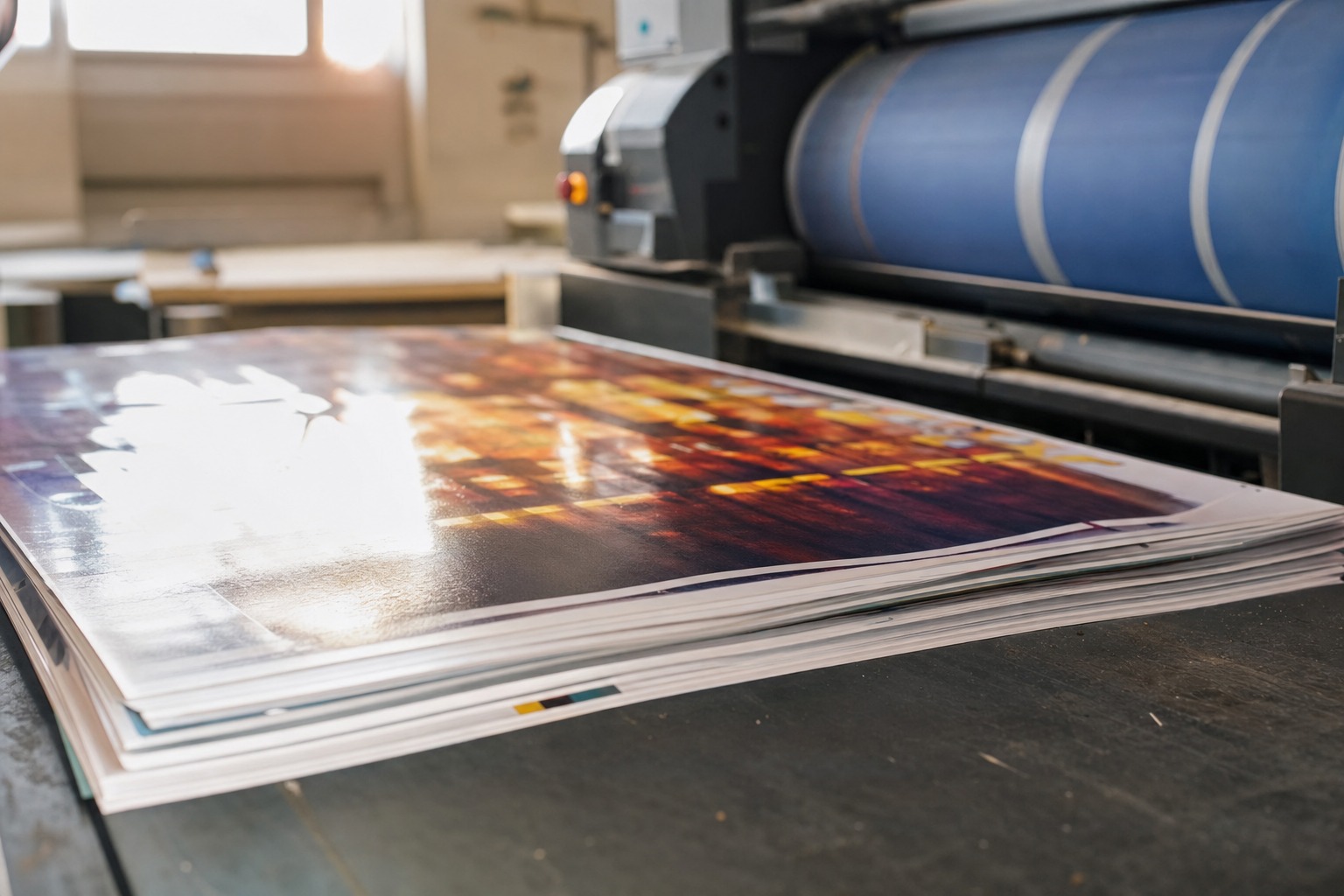
What HP Indigo Printing on Synthetic Substrates Enables
HP Indigo printing on synthetic substrates enables short-run, versioned and full-colour production directly on compatible plastic-based papers, films and card materials. Buyers can use it for durable labels, retail signage, packaging components, overlays, promotional cards and other applications that need more moisture or tear resistance than ordinary paper.
Unlike conventional offset or flexographic production, digital printing does not require a separate printing plate for every design. That makes HP Indigo particularly useful when a job involves:
- Multiple SKUs, languages or regional versions
- Frequent artwork changes
- Personalized text, images, barcodes or QR codes
- Prototypes and market tests
- Short and medium production runs
- Multi-store retail campaigns with location-specific content
“Direct printing” does not necessarily mean printing on untreated plastic. Many synthetic substrates require a print-receptive coating, primer or surface treatment to achieve reliable ink adhesion and image quality.
How HP Indigo Prints on Synthetic Materials
HP Indigo uses liquid electrophotography to transfer the printed image from a heated blanket to the substrate. This indirect transfer process supports a wider range of surfaces than systems that rely on direct inkjet deposition or high-temperature toner fusing.
HP describes Indigo as compatible with a broad selection of media, including plastic and film substrates. The practical selection still depends on the specific press, substrate thickness, surface chemistry, surface energy, treatment and intended use. Certified substrates provide a useful starting point, but the complete construction and application should still be evaluated.
The Role of the Transfer Blanket
HP Indigo ElectroInk first forms an image on the press blanket and is then transferred to the material. The technology’s linear contact between the blanket and substrate helps it print on synthetics and plastics that can travel correctly through the press.
This liquid electrophotography process can provide:
- Smooth colour gradients
- Fine type and detailed imagery
- Consistent image quality across versions
- Strong colour-to-colour registration
- A print appearance similar to offset lithography
The material must have sufficient dimensional stability for feeding, transport and finishing. Very stretchy, textured or slippery films may require testing, surface preparation or a different press configuration. Even when ink transfer is acceptable, poor runnability can cause feeding, registration or finishing problems.
Primer and Corona Treatment
Ink adhesion is one of the most important technical considerations when printing on synthetics. Plastic surfaces are often non-porous and may have low surface energy, so ElectroInk cannot simply absorb as it would on uncoated paper. The polymer’s surface chemistry also affects ink receptivity and the performance of primers or top coatings.
HP’s substrate preparation guidance recommends a primer layer for good ink transfer and adhesion. It also recommends corona treatment before priming synthetic materials, including metallized substrates.
Depending on the product, buyers can choose:
- A synthetic stock supplied as one of the certified substrates for the applicable press
- A factory top-coated material
- An offline-primed material
- A corona-treated film followed by an appropriate primer
- A tested combination approved by the printer and material supplier
A material that feels suitable is not necessarily print-ready. Its ink receptivity, coating and treatment history matter just as much as the base polymer. Surface treatments can also change or decay over time, so storage conditions and the interval between treatment and printing may affect ink adhesion.
One Shot Colour
On compatible HP Indigo presses, One Shot Colour transfers the colour separations to the substrate together rather than transferring each colour separately. This can improve registration and image quality on materials that are thin, flexible, heat-sensitive or prone to dimensional movement.
HP press documentation identifies one-shot printing on synthetics and metallized media as an available capability on applicable configurations. Availability should be confirmed for the press that will produce the job.
Synthetic Substrate Specifications and Options
Synthetic print specifications vary by press and application, so buyers should define performance requirements before selecting a material. Polymer type alone is not enough to determine whether a stock will print, finish or perform correctly.
| Specification | Options or considerations |
|---|---|
| Material type | Synthetic paper, polypropylene, BOPP, polyethylene, polyester, vinyl, static-cling film, metallized film or specialty card stock |
| Format | Sheets, rolls, pressure-sensitive films or unsupported films, depending on the press |
| Surface | Matte, satin, gloss, clear, opaque, white or metallized |
| Print readiness | Top-coated, pre-primed, corona-treated or prepared offline |
| Opacity | Opaque white, translucent or clear |
| Adhesive | Permanent, removable, repositionable, freezer-grade or application-specific |
| Thickness | Must remain within the selected press and finishing equipment limits |
| Ink options | CMYK, extended colours, white ink and specialty effects, subject to press configuration |
| Finishing | Lamination, varnish, die-cutting, scoring, perforation, foil or mounting |
| Variable data | Sequential numbering, regional copy, QR codes, barcodes and personalized graphics |
Biaxially oriented polypropylene, commonly called BOPP, is widely used for labels and packaging because it combines flexibility with moisture resistance. As with other pressure-sensitive films, it needs a suitable printable surface, adhesive and liner construction.
For labels, the construction includes more than the printable face stock. Adhesive, liner and release characteristics must also suit the container, application temperature, service environment and labelling equipment. Certified substrates may confirm press compatibility, but they do not automatically confirm suitability for every adhesive, container or exposure condition.
Where Synthetic HP Indigo Printing Is Most Useful
Synthetic HP Indigo printing is most useful when the printed piece needs durability, versioning or a non-paper appearance without the setup requirements of long-run analogue printing. Retail programs benefit because stores often need many coordinated items produced in different quantities and formats.
Labels and Packaging
Synthetic labels can tolerate moisture, handling and abrasion better than many paper labels. Typical applications include beverage containers, refrigerated foods, cosmetics, household products, health products and promotional packaging.
A dedicated labels & stickers workflow can combine HP Indigo printing with compatible pressure-sensitive films, adhesives, white ink, protective coatings and digital or conventional die-cutting. Product testing remains important, particularly for curved containers, oily surfaces, refrigeration and outdoor exposure.
Flexible packaging applications may include prototypes, sample pouches, short-run promotional packs and versioned packaging. Food, pharmaceutical and regulated applications require a review of the complete structure, including barriers, migration requirements, adhesives, coatings and sealing performance.
Retail Displays and Point-of-Sale Pieces
Synthetic paper and film are useful for point-of-sale materials that will be handled frequently or exposed to cleaning, moisture and changing temperatures. Examples include:
- Shelf talkers and shelf strips
- Counter cards
- Window graphics
- Hanging signs and danglers
- Menu inserts
- Product information overlays
- Floor and wall decals
- Reusable promotional cards
- Cooler and refrigerated-case graphics
Accent Impression produces HP Indigo synthetic print, labels and coordinated in-store pieces as part of its in-house retail-print program for multi-store rollouts across Canada.
Digital versioning allows one campaign to carry different offers, store addresses, languages or product selections. In Quebec, this is particularly useful when French-language requirements must be coordinated with bilingual or market-specific versions for other provinces.
Cards, Overlays and Specialty Graphics
HP Indigo can produce membership cards, event credentials, loyalty pieces, instructional overlays and premium postcards on compatible synthetic paper and specialty films. Clear or translucent materials can also create layered graphic effects.
The printer should distinguish promotional card applications from secure financial or government identification cards. Products involving encoded chips, magnetic stripes, tamper resistance or regulated personal information require specialized manufacturing and security controls.
How to Choose the Right Synthetic Material
The right material is the one that meets the application’s environmental, visual and finishing requirements, not simply the thickest or most durable option. A printer should match the stock, surface chemistry, surface treatment and finishing system to how the piece will actually be used.
Start With the Service Environment
Tell the printer whether the product will encounter:
- Water, condensation or refrigeration
- Oils, cleaners or chemicals
- Outdoor sunlight and temperature changes
- Repeated bending or handling
- Abrasion during shipping
- Low-temperature application
- Contact with curved, textured or flexible containers
Synthetic paper or film can improve resistance, but it is not automatically waterproof, UV-stable, chemical-resistant or suitable for every temperature. Ink, coating, adhesive and substrate must work as a complete system.
The material also needs enough dimensional stability and runnability for the chosen press and finishing process. A film that performs well after application may still be unsuitable if it stretches, curls or feeds inconsistently during production.
Decide Whether White Ink Is Needed
White ink can be important on clear, coloured or metallized materials. It may be printed behind colour graphics to preserve opacity, used as a selective design element, or applied as a flood layer.
Ask whether the artwork requires:
- Opaque colour on a clear label
- A no-label-look window
- Selective metallic areas
- Double-sided viewing through a clear film
- Different white-ink densities in the same design
White-ink capability and achievable opacity vary by press, number of hits, material and production speed.
Compare Digital With Analogue Production
HP Indigo is often a strong fit for short runs, multiple versions and variable data. Flexography, screen printing or offset may be more economical for stable, high-volume work, depending on size, colours, material and finishing.
Compare the total program rather than only the unit print price. Include plates, setup waste, inventory, obsolete versions, finishing, packing and distribution. A digitally produced version may reduce overprinting when quantities are uncertain or artwork changes regularly.
Proofing, Testing and Finishing Requirements
A production sample on the actual substrate is the safest way to approve a synthetic print job. Screen proofs and paper proofs cannot fully represent ink adhesion, opacity, metallic interaction, flexibility or final surface feel.
Before approving production, verify:
- Colour and image quality on the selected material
- White-ink coverage, if applicable
- Ink adhesion after curing and handling
- Resistance to scratching and cleaning
- Adhesive performance on the real container or surface
- Die-cutting, scoring and folding behaviour
- Laminate or varnish compatibility
- Barcode and QR-code readability
- Fit within displays, fixtures or packaging components
Retail rollout samples should also be tested in a representative store environment. Lighting, window exposure, refrigeration and fixture surfaces can reveal issues that are not visible at a desk.
Frequently Asked Questions
Can HP Indigo print on any plastic?
No. The material must be compatible with the specific press, transport path, temperature range and ElectroInk transfer process. It may also need corona treatment, primer or a factory-applied receptive coating. A material listed among certified substrates should still be checked against the job’s finishing and service requirements.
Is HP Indigo printing on synthetic substrates waterproof?
The synthetic base may resist water, but the finished product’s water resistance depends on the ink, primer, coating, adhesive, edges and exposure conditions. Request testing when the application involves immersion, condensation or repeated cleaning.
Can variable data be printed on synthetic materials?
Yes. HP Indigo can change text, images, numbers, barcodes and other content from one impression to the next. This supports serialized labels, localized promotions, store-specific signage and personalized cards.
Are synthetic substrates recyclable in Canada?
Recyclability depends on the polymer, local collection program, adhesives, laminates and how the printed item is used. Municipal acceptance varies across Quebec and Canada. Buyers should verify claims with the material supplier and the relevant recycling stream before placing environmental statements on a product.
Is lamination always necessary?
No. Lamination may add abrasion, moisture, chemical or UV resistance, but it also changes cost, stiffness, appearance and recyclability. A varnish or inherently durable material may be sufficient, depending on the job.
What information does a printer need to quote the job?
Provide the finished size, quantity, number of versions, artwork, material preference, use environment, adhesive needs, finishing, packing and delivery locations. If the material is not already specified, describe the required performance so the printer can recommend and test an appropriate construction.
Request a quote
Have a print or packaging project? Talk to our team. We take it from concept to delivery, on our own presses, here in Montreal.