
Short answer: choose validated sterilization paper, not ordinary synthetic paper
Medical-grade sterilization paper and certain paper/plastic pouch structures can survive steam autoclave cycles when validated for the intended temperature, dwell time, pressure, drying phase, and load configuration. Tyvek and general-purpose synthetic paper should not be treated as steam-autoclavable substitutes.
The important distinction is that “synthetic paper” is a printing category, not a sterilization rating. A sheet may offer moisture resistance, tear strength, and chemical resistance yet still soften, shrink, delaminate, distort, shed, or lose print adhesion during steam sterilization.
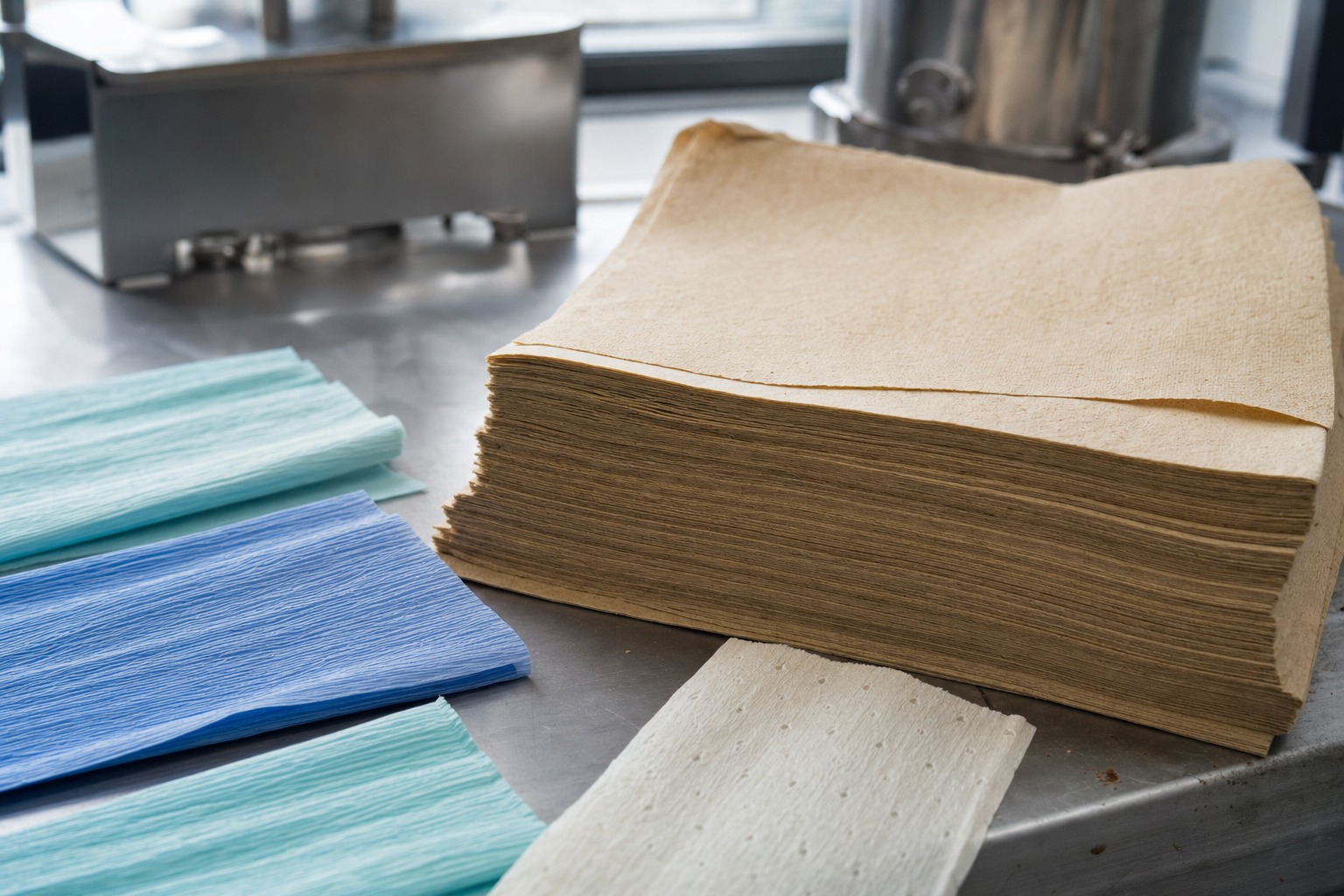
For sterile-barrier packaging, medical-grade kraft or crepe paper is usually the more defensible paper choice. These materials are engineered to let the sterilant pass through while maintaining package integrity. A medical-packaging comparison identifies medical-grade kraft and crepe papers as compatible with steam and ethylene oxide sterilization.
Which material options should buyers compare?
The principal options are medical-grade sterilization paper, validated paper/plastic pouches, purpose-made autoclavable documentation paper, and specially engineered identification constructions. Ordinary waterproof synthetic paper and standard Tyvek should generally be excluded unless the manufacturer provides applicable steam-cycle data.
Medical-grade kraft sterilization paper
Medical-grade kraft is a porous cellulose material used in pouches, reels, and as lidding for medical packaging. Although it is not a plastic-based sheet, it is often the correct answer when a buyer needs a printable material that can pass through steam sterilization.
Look for:
- A declared steam-sterilization application
- Porosity suitable for sterilant penetration and drying
- Wet strength and dimensional stability
- Compatibility with the sealing film or tray
- Manufacturer data for the intended cycle
- Low linting and controlled cleanliness
- Print systems suitable for the sterile-barrier application
The paper, coating, print, seal, and mating film must be assessed as a complete package. Specifying medical paper alone does not establish that the finished package will remain sterile.
Medical-grade crepe paper
Crepe paper is commonly used for wrapping instrument sets and other healthcare products. Its creped structure provides flexibility around irregular shapes while supporting steam penetration.
Buyers should evaluate basis weight, tear resistance, drape, linting, wrap method, and compatibility with the sterilization process. Crepe paper intended for wrapping should not automatically be converted into identification stock, instruction sheets, or pouch lids without confirmation from the material manufacturer.
Paper/plastic sterilization pouches
A paper/plastic pouch combines porous medical paper with a transparent film. Steam enters through the paper side, while the film allows visual identification of the contents.
Construction details matter, including seal width, peel behaviour, puncture resistance, ink placement, and the compatibility of any chemical indicator. An indicator can confirm exposure to specified process conditions, but it does not by itself prove sterility.
In one peer-reviewed controlled study, paper/plastic pouches maintained barrier integrity through up to five resterilizations and six months of closed storage. That finding supports the potential durability of an appropriate pouch structure, but it does not validate every pouch, print design, sealing process, or reuse protocol.
Purpose-made autoclavable paper
Some papers sold for cleanroom records, laboratory notes, batch documents, and equipment identification are specifically described as autoclavable. These products may use engineered fibres, binders, coatings, or blended constructions.
Do not rely on the word “autoclavable” by itself. Request the exact tested temperature, exposure time, drying time, number of cycles, dimensional-change results, and printing limitations. A paper validated for one sterilization cycle may not tolerate a hotter prevacuum cycle or repeated processing.
Autoclavable labels
A label is a multi-component system consisting of a face stock, printable coating, ink or toner, adhesive, and release liner before application. Each component can respond differently to heat, moisture, pressure, and cooling.
Polyester face stocks are often considered where heat resistance and dimensional stability are important. However, the polymer name alone does not establish steam compatibility. Coatings can cloud or lift, printing can transfer, and an unsuitable adhesive can creep or detach during condensation and drying.
For identification applied before autoclaving, buyers should specify:
- The container material and surface finish
- Application temperature
- Curved or flat surface
- Steam-cycle temperature and duration
- Number of expected cycles
- Exposure to condensation
- Required barcode grade after processing
- Need for tamper evidence or traceability
- Resistance to cleaning chemicals after sterilization
A heat-resistant face stock can still fail if its adhesive lifts from glass, stainless steel, or polypropylene. Barcode readability must also be tested after the full cycle, not merely after dry-heat exposure.
Why is Tyvek usually the wrong choice for steam autoclaving?
Tyvek should not be specified as a general steam-autoclave paper because it is made from high-density polyethylene, or HDPE, rather than medical-grade cellulose paper. Any steam use depends on tightly controlled conditions supported by manufacturer data.
DuPont reports maintained tensile strength, microbial barrier, and porosity after steam exposure under specific conditions of 121°C to 127°C, at 30 psi for 30 minutes. That information should not be broadened into a claim that every Tyvek grade, package design, seal, or printed construction is suitable for any autoclave cycle.
Medical-packaging references generally favour Tyvek for sterilization methods such as ethylene oxide and certain radiation processes, while identifying its HDPE base as a concern at steam temperatures. A buyer considering Tyvek for steam must obtain written confirmation for the exact grade, package construction, cycle, and equipment.
A polymer’s published melting point is not a sufficient qualification criterion. Dimensional change, softening, seal stress, coating failure, and loss of barrier performance can occur below the nominal melting point, especially under saturated steam and mechanical load.
Tyvek may still be an excellent choice for an application using a compatible sterilization method. The problem is not the material’s overall performance. It is the assumption that water resistance and tear strength equal compatibility with saturated steam.
Which autoclave specifications must be defined?
A useful specification states the complete sterilization process, not simply “must survive autoclaving.” Temperature alone does not describe the combined effects of steam, pressure, exposure time, vacuum pulses, condensation, and drying.
Cycle temperature and dwell time
Wrapped healthcare loads may be processed under different sterilizer cycles, including gravity-displacement and prevacuum cycles. Common reference conditions include 121°C for longer exposures and 132°C or 134°C for shorter exposures. The approved sterilization cycle depends on the load, sterilizer, product, packaging, applicable procedure, and required sterility assurance.
A construction that survives 121°C is not automatically suitable for 134°C. The higher-temperature cycle may produce different shrinkage, curl, adhesive flow, or print failure even when the exposure is shorter.
Record the maximum conditions the printed item may encounter, including an overrun or repeated cycle if that is reasonably foreseeable.
Drying and cooling
Failures often appear during drying or cooling rather than during steam exposure. Layers can curl, seals can become stressed, adhesives can creep, and inks can offset while the package remains warm and damp.
The test protocol should therefore include the full drying phase and handling after unloading. Samples should cool under the same conditions expected in production.
Number of cycles
Single-use packaging and reusable identification labels require different constructions. State whether the item must survive one validated cycle, occasional reprocessing, or repeated sterilization over its service life.
“Autoclavable” does not automatically mean reusable. Repeated-cycle performance must be supported by testing.
Print and finishing requirements
Steam can affect inks, varnishes, laminates, adhesives, foil, and variable data. Areas intended to permit steam transmission should not be covered indiscriminately by heavy ink films or coatings.
Accent Impression produces regulated print components through its pharmaceutical packaging service, including printed packaging and identification constructions specified for controlled applications.
For barcodes, lot numbers, expiry data, and instructions, test contrast, adhesion, legibility, and scan performance after sterilization. Finishing operations such as die-cutting and perforation must also avoid fibres, rough edges, or pathways that compromise the package.
A printed chemical indicator must be selected for the relevant process and evaluated as part of the finished construction. Its colour response should not be confused with validation of sterilization efficacy or sterile-barrier integrity.
How should a steam-compatible paper be qualified?
Qualification should test the finished printed construction under the intended sterilization cycle and load conditions. A supplier data sheet is the starting point, while package and process validation determine whether the actual application is acceptable.
A practical qualification plan includes:
- Material identification: Record the manufacturer, grade, basis weight or thickness, coating, and production lot.
- Print construction: Document inks, toner, coatings, adhesives, sealants, and finishing processes.
- Pre-cycle inspection: Measure dimensions, seal quality, print quality, barcode performance, and visible defects.
- Full-cycle exposure: Use the intended sterilizer, load pattern, temperature, dwell, pressure, vacuum, and drying conditions.
- Post-cycle inspection: Check curl, shrinkage, brittleness, delamination, tearing, colour change, adhesive lift, and ink transfer.
- Functional testing: Assess sterile-barrier integrity, seal strength, peel characteristics, or adhesion as applicable.
- Worst-case testing: Include maximum print coverage, the most difficult substrate, repeated cycles if relevant, and storage after sterilization.
- Change control: Reassess performance when the paper grade, adhesive, ink, seal setting, sterilizer cycle, or packaging dimensions change.
Heat resistance should be evaluated under moist conditions, not inferred from a dry-oven test. Steam sterilization exposes the construction to heat, saturated moisture, pressure changes, and subsequent drying, which can produce failure modes not seen with dry heat.
For sterile medical packaging in Canada, qualification should align with the organization’s quality system and applicable sterile-barrier and healthcare-reprocessing requirements. Material suitability and sterilization efficacy are related, but they are not the same validation.
What buying decision is safest for each use case?
Choose medical-grade sterilization paper for porous sterile barriers, a validated pouch system for visible packaged contents, and purpose-made autoclavable stock for documents or identification. Avoid substituting general synthetic paper based only on waterproof, moisture-resistant, or tear-resistant claims.
| Use case | Preferred starting point | Main buying concern |
|---|---|---|
| Instrument or device pouch | Medical paper plus compatible film | Seal and barrier integrity |
| Tray lidding | Validated medical-grade porous paper | Seal compatibility and clean peel |
| Instrument wrap | Medical crepe sterilization paper | Tear resistance, drape, and lint |
| Cleanroom documentation | Purpose-made autoclavable paper | Legibility, dimensional stability, and shedding |
| Container identification | Validated autoclave label system | Adhesion and barcode readability |
| Steam process indicator | Qualified indicator construction | Correct response under the specified cycle |
| General waterproof tag | Do not assume suitability | Heat distortion, ink, and attachment method |
| Tyvek sterile barrier | Usually select another sterilization method | Grade-specific temperature limitations |
Frequently asked questions
The questions below address the most common specification errors involving steam, polymer-based papers, sterile packaging, and printed identification. The consistent rule is to qualify the entire printed construction under the actual cycle.
Is waterproof synthetic paper autoclavable?
Not necessarily. Waterproofing indicates resistance to liquid water, not resistance to saturated steam, heat, pressure, vacuum, or repeated drying. Request cycle-specific manufacturer data and test the printed sheet.
Can polypropylene synthetic paper survive an autoclave?
Some polypropylene products tolerate certain temperatures, but a printable sheet also contains coatings, fillers, inks, and sometimes adhesives. Suitability varies by grade and cycle, so it cannot be approved based on the polymer name, heat resistance, or melting point alone.
Can Tyvek go through a 121°C steam cycle?
Only if the exact Tyvek grade and finished package have documented compatibility with the specified conditions. Controlled manufacturer testing must not be interpreted as universal approval for all Tyvek packaging or for hotter 134°C cycles.
Is medical-grade paper considered synthetic paper?
No. Medical-grade kraft and crepe papers are primarily cellulose-based porous materials. They are included in this guide because they are often the correct steam-compatible alternative to plastic-based printable sheets.
Can an autoclave-safe sheet be used as sterile-barrier packaging?
Not automatically. Surviving the cycle does not demonstrate microbial-barrier performance, seal integrity, sterilant penetration, or maintenance of sterility. Sterile-barrier packaging requires separate package-system validation.
Do printed autoclave labels require post-cycle barcode testing?
Yes. Heat, moisture, surface movement, ink changes, and adhesive creep can reduce barcode contrast or distort dimensions. Scan testing should occur after the complete sterilization, drying, cooling, and storage sequence.
Request a quote
Have a print or packaging project? Talk to our team. We take it from concept to delivery, on our own presses, here in Montreal.