
Which Label Options Work Best for Surgical Instrument Trays?
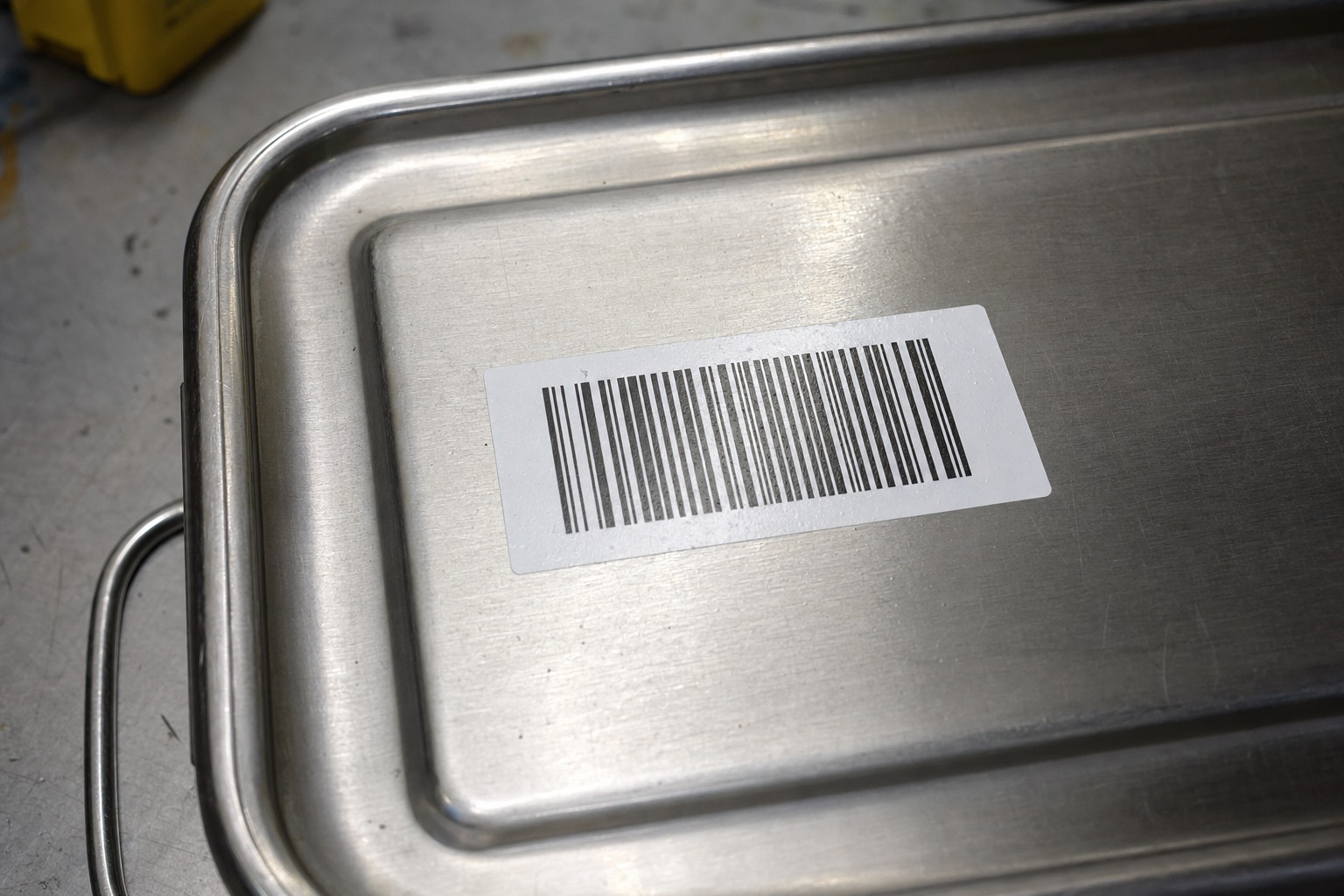
The best tear resistant waterproof labels for surgical instrument trays are usually autoclave-rated synthetic labels printed by thermal transfer. For trays that cannot accept adhesive, self-looping identification tags are generally the safer alternative.
The right construction depends on whether the label remains on the tray during processing, how often the tray is cycled, which chemicals contact it, and whether the information is fixed or variable. “Waterproof” alone is not enough. A suitable label must preserve adhesion, print contrast, barcode readability and physical integrity throughout the facility’s actual workflow.
| Label option | Relative cost | Durability and print quality | Best use case |
|---|---|---|---|
| Autoclave-rated synthetic pressure-sensitive label | Medium | Strong moisture, heat and tear resistance when correctly matched | Direct application to compatible tray surfaces |
| Thermal-transfer synthetic label | Medium | Crisp variable text and codes, with durability determined by stock and ribbon | On-demand identification and traceability |
| Overlaminated synthetic label | Medium to high | Added protection against abrasion, wiping and chemicals | Long-term markings exposed to repeated handling |
| Self-looping synthetic tag | Medium to high | No adhesive-to-tray dependency, good visibility | Wire baskets, handles and surfaces unsuitable for adhesive |
| Synthetic paper label or tag | Low to medium | Water and tear resistant, with heat performance varying by product | Temporary or intermediate identification in wet environments |
| Standard paper label | Low | Poor around moisture, tearing and sterilization | Dry, temporary staging only |
| Direct marking or engraved plate | High initial cost | Excellent permanence, limited flexibility for changing data | Fixed asset identification |
Autoclave-Rated Synthetic Labels vs Standard Waterproof Labels
Choose an autoclave-rated synthetic label when the identification must remain attached during steam sterilization. Choose a general waterproof label only when it will encounter moisture without the heat, pressure or aggressive chemicals associated with tray processing.
A standard waterproof film or synthetic paper may resist splashes and brief cleaning, but that does not prove it will survive a complete processing cycle. Steam can soften adhesives, encourage edge lift and affect print. Rapid temperature changes and repeated handling can further stress the construction.
Autoclave-rated labels are built as a system consisting of:
- A heat-tolerant synthetic face material
- An adhesive suited to the tray surface and processing conditions
- An ink, toner or thermal-transfer ribbon compatible with the face material
- A construction tested for the intended method and cycle
Some commercially available autoclave labels are specified for repeated steam cycles at 121°C, hot-air exposure up to 150°C and other demanding processes, although suitability varies by product and application (autoclave-resistant label specifications). These values should not be treated as universal. Buyers need documentation for the exact material, adhesive and print combination being ordered.
The processing method matters as well. A label qualified for steam is not automatically suitable for gas plasma sterilization, dry heat or another low-temperature system. Compatibility must be confirmed for the chemistry, pressure and exposure time involved.
Choose autoclave-rated synthetic labels when:
- The label enters the sterilizer with the tray
- Variable tray data or a barcode must remain readable
- Moisture and cleaning are part of routine sterile processing
- A pressure-sensitive label is permitted on the selected surface
- The facility has validated the construction for its cycle
Choose general waterproof labels when:
- The label is applied after sterilization
- Exposure is limited to condensation, splashes or routine transport
- The label is temporary
- Heat and pressure resistance are not required
Polyester vs Polypropylene vs High-Temperature Synthetic Films
Polyester is often the balanced choice for durable tray labels, while polypropylene is better suited to moderate conditions. Specialized high-temperature films are reserved for severe processing requirements. Material names alone do not determine performance because coatings, adhesives and printing methods also matter.
| Material family | Relative cost | Quality and durability | Choose it when |
|---|---|---|---|
| Polyester | Medium | Good dimensional stability, tear resistance and print definition | The label needs dependable all-around durability |
| Polypropylene | Low to medium | Flexible and moisture resistant, but performance varies under heat | The application is wet but not necessarily autoclaved |
| High-temperature synthetic film | High | Designed for demanding heat exposure and dimensional stability | Documented process resistance is essential |
| Synthetic paper | Low to medium | Tear and water resistant, but available in constructions with different heat limits | Flexible identification is needed in a wet workflow |
| Synthetic tag stock | Medium to high | Tear resistant without depending on adhesive contact | The label will loop around a handle or basket |
| Paper | Low | Easy to print, but vulnerable to water and tearing | Identification is temporary and kept dry |
Polyester is frequently selected for pressure-sensitive labels because it accepts high-resolution printing and resists tearing better than paper. It can also be paired with specialized adhesives and thermal-transfer ribbons.
Polypropylene is useful for bottles, pouches and other applications requiring flexibility and moisture resistance. It should not automatically be specified for autoclaving. A polypropylene label described as waterproof may still shrink, lift or lose print quality under process conditions.
Synthetic paper is a broad category rather than a single material. Some products are printable, waterproof and tear resistant, but their adhesives, coatings and temperature limits differ. Product documentation must establish whether a particular construction is appropriate for surgical instrument trays.
High-temperature films can provide stronger performance, but they cost more and may require particular ribbons or printer settings. Product data and application testing should guide the decision.
Pressure-Sensitive Labels vs Self-Looping Tags
Choose pressure-sensitive labels for compact identification on a validated, smooth tray surface. Choose self-looping identification tags when adhesive residue, textured surfaces, small contact areas or repeated tray processing make direct adhesion unreliable.
Pressure-sensitive labels are space-efficient and can carry tray IDs, dates, status information and scannable data. Their performance, however, depends heavily on surface preparation. Stainless steel, anodized metal, rigid polymers and coated surfaces do not all behave the same way.
Self-looping tags attach mechanically around a handle, wire or tray feature. They can avoid adhesive contact with the tray and are easier to remove when information changes. The trade-offs are a larger physical profile and a greater possibility of snagging or interfering with handling if the tag is poorly positioned.
Some facilities also use approved tie wraps to secure identification tags. Ordinary tie wraps should not be substituted without review because they may become brittle, deform, retain soil or interfere with cleaning. The tag and attachment must both be compatible with the process and positioned so they do not obstruct tray closure, drainage or handling.
Self-looping medical labels are supplied with application instructions, illustrating why the attachment method should be treated as part of the specification rather than an afterthought (self-looping label instructions for use).
Accent Impression produces custom medical and industrial labels & stickers on its own printing equipment in Quebec, with material, adhesive and finishing choices matched to the application.
Thermal Transfer vs Laser Printing
Thermal transfer is usually the best option for variable tray IDs and barcode data that need strong abrasion and chemical resistance. Laser printing can suit office-driven workflows, but only when the synthetic sheet and printer are approved for the application.
Thermal transfer
Thermal-transfer printers use a ribbon to place the image on the label. The ribbon chemistry must match the face stock. Resin ribbons generally provide greater resistance than basic wax ribbons, but the final choice depends on the synthetic material, cleaning exposure and required print speed.
A compatible resin ribbon can produce a smudge-proof ink image after printing, but that description should be supported by testing against the facility’s cleaners and handling methods.
Choose thermal transfer when:
- Printing variable codes or serial numbers
- Producing labels near the sterile processing workflow
- High contrast and scanner readability matter
- A validated stock-and-ribbon combination is available
Laser printing
Laser-printable synthetic sheets can simplify short runs and decentralized printing. Heat inside the printer can affect unsupported materials, so an unspecified synthetic stock should never be fed through a laser device.
Choose laser when:
- Labels are printed in batches
- Sheet-fed handling fits the workflow
- The stock is approved for the printer
- Variable data requirements are straightforward
Some synthetic labels are explicitly described as waterproof and tear-proof for applications that include surgical instruments and steam autoclave cycles (durable synthetic label catalogue). That claim still needs to be checked against the actual cycle, surface and printing process used by the healthcare facility.
Overlaminated vs Unlaminated Labels
Choose an overlaminate when repeated rubbing, chemical wiping or metal-to-metal contact threatens the printed image. Choose an unlaminated construction when the validated print system already provides sufficient resistance and label thickness must be minimized.
An overlaminate is a clear protective film applied over the printed label. It can shield text, colour coding and a barcode from abrasion and cleaning chemicals. It may also improve resistance to moisture reaching the printed surface.
The disadvantages are additional cost, thickness and production steps. A laminate can create new edge-lift risks if the construction is not properly converted. It also does not compensate for an adhesive that is unsuitable for the tray or process.
For variable information printed at the healthcare facility, lamination may complicate the workflow. In those cases, a durable thermal-transfer ribbon paired with a compatible synthetic stock may be more practical.
Writable Labels, Indicator Dots and Manual Identification
Writable labels can be useful when staff must add a date, initials or other short variable information by hand. The label coating and writing instrument must be compatible. A permanent marker may appear durable at room temperature yet fade, bleed or transfer after exposure to steam, chemicals or abrasion.
Smudge-proof ink should remain legible after the required drying time and throughout the intended workflow. Handwritten information should be evaluated for contrast, character clarity and resistance to wiping just as printed information is.
Indicator dots can provide a visible process-exposure cue or support colour-coded identification, depending on their design. They do not establish that an item is sterile and should not replace the facility’s required chemical, biological or record-based controls. If indicator dots remain attached to a tray, their adhesive and ink also require compatibility testing.
How Cost Should Be Compared
Compare total process cost, not simply the price per label. A lower-cost label becomes expensive if it detaches, becomes unreadable, requires manual relabelling or interrupts traceability.
The main cost factors include:
- Face material and adhesive type
- Autoclave or chemical-resistance requirements
- Label dimensions and shape
- Permanent versus removable adhesive
- Printing method and ribbon
- Overlamination or protective coating
- Code verification requirements
- Number of versions or SKUs
- Roll configuration and order volume
- Testing, documentation and validation needs
- Separate tags, tie wraps or other attachment components
Paper usually has the lowest unit price, but it is a poor comparison point for wet, high-temperature processing. Polyester and other synthetic films cost more but can reduce failures where tear resistance and moisture resistance are mandatory. Specialized constructions carry a further premium.
Exact prices vary by job. Samples should be compared under actual use conditions before a full production quantity is approved.
What Should Be Tested Before Approval?
A label for surgical instrument trays should be tested through the complete cleaning, sterilization, storage and handling sequence in which it will be used. Testing only adhesion at room temperature does not represent real processing conditions.
A practical evaluation should examine:
- Initial adhesion: Does the label wet out and bond to the clean tray surface?
- Process exposure: Does it remain attached after the specified cycle?
- Moisture resistance: Does water reach the print layer or adhesive?
- Chemical resistance: Does wiping smear, fade or soften the image?
- Tear resistance: Can the label withstand handling without splitting?
- Abrasion resistance: Do text and machine-readable codes remain clear after contact and rubbing?
- Edge integrity: Is there lifting, curling or residue?
- Scanner performance: Can the code be read before and after processing?
- Removal behaviour: If removable, does it release cleanly at the required stage?
- Repeat cycles: If reuse is intended, does performance remain acceptable over the validated number of cycles?
- Attachment safety: Do loops or tie wraps remain secure without obstructing cleaning, drainage or tray handling?
Testing should reflect the exact method used, including steam, dry heat or gas plasma sterilization when applicable. Approval for one process should not be assumed to cover another.
The approved specification should document the artwork, material, adhesive, printing system, ribbon or ink, attachment location, inspection method and acceptance criteria. Any change to one component can affect the complete construction.
Clear Recommendations by Use Case
The best choice depends on whether the label is permanent, variable, adhesive-backed or mechanically attached. These recommendations provide a starting point, but the final construction should be validated under the healthcare facility’s operating conditions.
Choose an autoclave-rated polyester label when:
- A durable pressure-sensitive label is permitted
- The tray has a smooth, clean application area
- Moisture, heat and routine handling are expected
- Variable data needs to remain legible
Choose a specialized synthetic film when:
- The process is especially demanding
- Multiple cycles are expected
- Dimensional stability is critical
- Supporting technical documentation is required
Choose a self-looping synthetic tag when:
- Adhesive cannot contact the tray
- The surface is textured, perforated or too small
- Labels must be removed or replaced regularly
- A handle or wire attachment point is available
Choose an overlaminated label when:
- Printed information faces heavy abrasion
- Cleaning chemicals contact the image repeatedly
- Colour coding or small text must remain protected
- The added thickness does not interfere with processing
Choose paper only when:
- The application is temporary
- The label remains dry
- It is removed before washing or sterilization
- Failure would not compromise identification or traceability
Frequently Asked Questions
Are all waterproof labels safe for autoclaves?
No. Waterproof indicates resistance to water, not necessarily resistance to steam, pressure, heat or repeated processing. The complete label construction must be rated and tested for the intended cycle.
Will a tear-resistant label leave adhesive on a surgical tray?
It depends on the adhesive, surface, dwell time and process. Permanent adhesives prioritize retention, while removable systems prioritize clean release. Both require testing on the actual tray material.
Can printed codes survive steam processing?
Yes, with a compatible synthetic stock, adhesive and print system. Readability should be verified afterward because heat, abrasion, chemicals or surface distortion can reduce scanner performance.
Is polyester always the best material?
No. Polyester is a strong general-purpose option, but a specialized film or self-looping tag may be better for severe cycles or unsuitable bonding surfaces. Polypropylene may be sufficient for wet applications that do not enter a sterilizer.
Should tray labels be permanent or removable?
Permanent labels suit fixed asset information. Removable labels suit changing status, cycle or case information. The choice should follow the facility’s traceability procedure and contamination-control requirements.
How many processing cycles should a label withstand?
That varies by product and intended use. A single-use process label and a permanent tray identifier have different requirements. Specify the expected number and type of cycles, then validate the complete label system accordingly.
Request a quote
Have a print or packaging project? Talk to our team. We take it from concept to delivery, on our own presses, here in Montreal.