

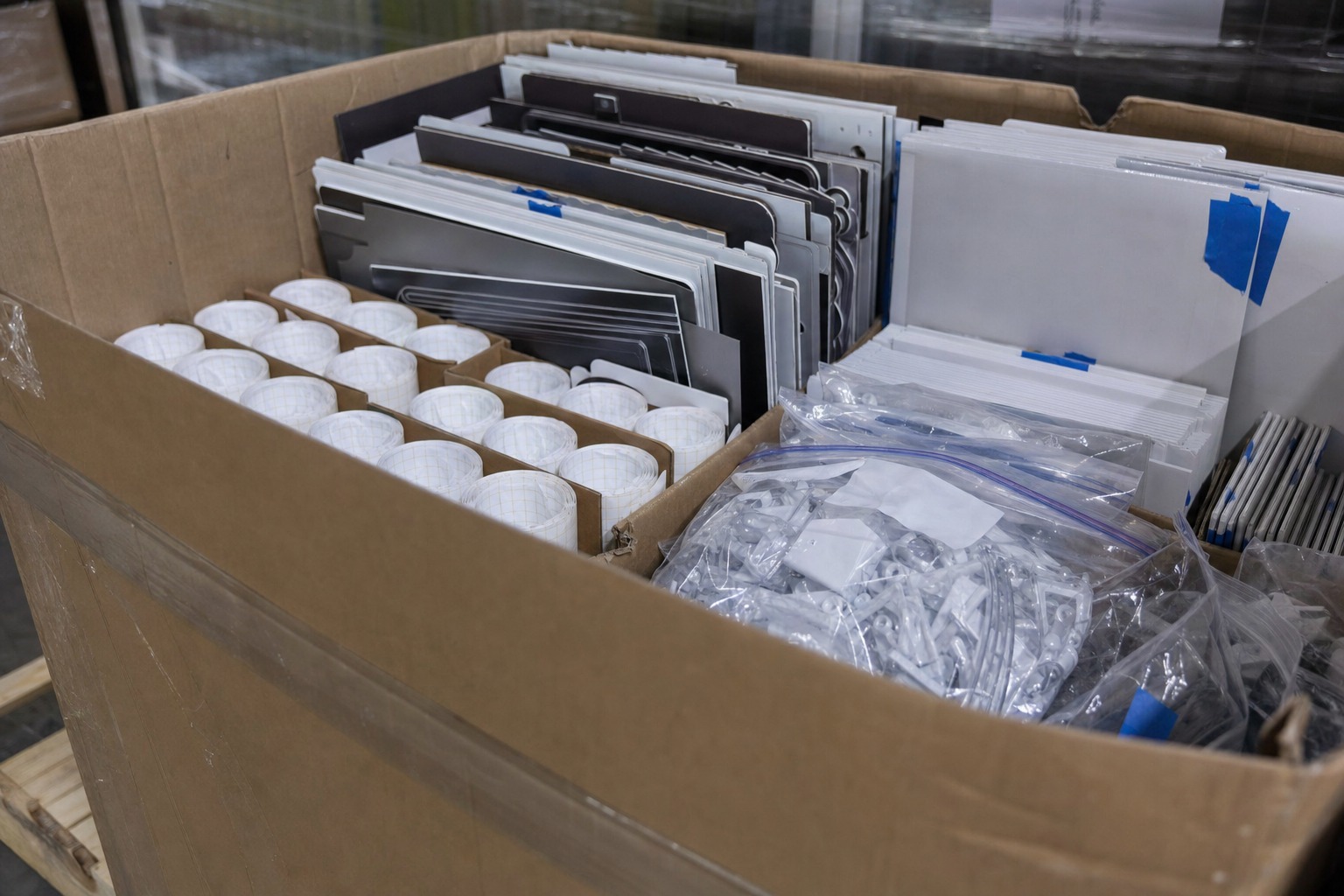
What is the best model for a retail store rollout?
For most multi-location launches, centralized printing, store-specific kitting and coordinated fulfillment provide the strongest control over colour, quality, inventory and delivery. Decentralized or hybrid production can be appropriate when the timeline, geography or local customization makes central production impractical.
A retail store rollout may include window graphics, posters, shelf talkers, floor decals, counter cards, point-of-purchase displays, point-of-sale materials, price signage, packaging, labels, marketing collateral and installation hardware. The challenge is not simply producing these pieces. It is ensuring that every store receives the correct version, quantity and installation materials for its location.
Three production models are commonly considered:
- Centralized printing and kitting
- Decentralized regional or local production
- Hybrid production
The right choice depends on the number of stores, campaign complexity, quality requirements, delivery geography, logistics and tolerance for variation. A multi-location launch tied to a store opening may also require tighter control than an ongoing promotional program.
Centralized, decentralized and hybrid rollouts compared
Centralized production offers the greatest consistency, while decentralized production prioritizes local speed and flexibility. A hybrid model divides the program according to which materials benefit from standardization and which require regional production.
| Dimension | Centralized printing and kitting | Decentralized production | Hybrid production |
|---|---|---|---|
| Cost structure | Consolidates setup, production and purchasing; adds freight from one facility | May reduce local freight; duplicates setup and management across suppliers | Balances consolidated production with selective local spending |
| Print quality | Strongest control over colour, substrates and finishing | Greater risk of variation between vendors and equipment | Consistent for core graphics, variable for locally produced items |
| Brand consistency | High, with one approved specification and production workflow | Depends on each supplier following the same standards | High for national elements, moderate for local elements |
| Speed | Efficient for planned launches and large quantities | Useful for urgent local needs | Useful when national and local deadlines differ |
| Kit accuracy | Store-level packages can be checked before shipping | Stores or regional teams may need to sort materials | Central kits can be combined with locally produced pieces |
| Customization | Supports variable data, but changes require disciplined file control | Easier for small local changes | Well suited to national templates with regional versions |
| Fulfillment and distribution | One workflow can coordinate packing, inventory and shipment | Separate suppliers manage local deliveries | Responsibilities are divided between central and regional teams |
| Project management | One production schedule and accountability structure | Multiple vendors, purchase orders and approval paths | Requires clear ownership between central and regional teams |
| Best use case | Coordinated national or provincial launches | Small, isolated or highly localized campaigns | Large programs with predictable national and regional components |
When should printing and kitting be centralized?
Choose centralized production when stores must launch together, brand consistency is critical and each location needs a controlled package of graphics and hardware. This model is usually the most dependable option for national campaigns, seasonal resets, product introductions, rebrands and coordinated store opening programs.
Cost and purchasing control
Central production combines quantities across the store network. This can reduce duplicated setup work and make it easier to purchase approved substrates, finishing and hardware consistently. It also supports inventory management by providing one view of materials produced, packed, shipped, held for replacement or carried into a later campaign phase.
Freight remains an important consideration. Shipping from one plant may cost more for remote locations, especially when kits contain rigid displays or oversized graphics. However, freight should be evaluated against the hidden costs of decentralized production, including repeated approvals, separate supplier charges, inconsistent materials and store labour spent sorting deliveries.
Colour and production consistency
One production site can apply the same approved files, colour targets, substrates and finishing methods across the full run. It also allows press sheets, samples and finished items to be evaluated under one quality-control process.
This matters when the campaign combines several formats. A header card produced on paperboard, a window graphic printed on film and a fabric display will not reproduce colour identically. Centralized control makes those differences easier to measure, approve and document instead of relying on visual judgment at multiple suppliers.
Consistent production is particularly important for point-of-sale materials and marketing collateral that customers may see at several locations during the same campaign.
Store-specific kit accuracy
A centralized kit can be organized by store number, department, installation area or launch phase. Each carton can include only the items intended for that location, along with a packing list, mounting hardware and instructions.
Packaging by store reduces the likelihood that installation teams will receive graphics for the wrong location or spend time sorting mixed campaign materials. It also creates a clear inspection point before shipment and connects production with fulfillment, distribution and inventory management.
When does decentralized production make sense?
Choose decentralized production when a program involves a small number of distant stores, urgent replacements or substantial local content. It can shorten final-mile delivery, but it requires tighter supplier specifications and more administrative oversight.
Local speed and responsiveness
Regional production may be useful for late changes, damaged-graphic replacements or promotions that apply to only one market. A local printer can sometimes produce and deliver a short run faster than a central plant can manufacture and ship it.
This flexibility can help protect a compressed timeline, especially when a store opening date cannot move or when final content is approved shortly before installation.
The trade-off is repetition. Each regional supplier may need separate files, instructions, proofs, approvals and purchase orders. If several vendors interpret a specification differently, stores can receive noticeably different results.
Quality and material variation
Different printers may use different presses, inks, films, boards, laminates and cutting equipment. Even when dimensions match, the final pieces may vary in colour, opacity, stiffness, gloss or adhesive performance.
Written specifications should therefore identify approved materials, colour targets, finishing, dimensions, mounting methods and acceptable tolerances. Centralized file control is also essential because every supplier must work from the same approved artwork version.
Appropriate use cases
Decentralized production is generally better for:
- One-off replacements needed near a store
- Short-term regional promotions
- Market-specific regulatory or language changes
- Small campaigns with limited overlap between locations
- Materials that are expensive or difficult to ship long distances
- Graphics produced only after final site measurements are available
- Local point-of-sale materials tied to a specific offer or event
It is less suitable for a tightly coordinated national multi-location launch where customers will compare the same display across multiple stores.
When is a hybrid rollout the better alternative?
Choose a hybrid rollout when national campaign materials require consistent production but certain pieces are more practical to print or source locally. The model works well when responsibilities, specifications, fulfillment processes and delivery deadlines are clearly separated.
A common arrangement is to produce high-visibility brand pieces centrally while assigning simple, time-sensitive or region-specific materials to approved local suppliers.
For example, central production may cover:
- POP displays and structural components
- Window and entrance graphics
- Shelf talkers and danglers
- Branded packaging and labels
- Promotional inserts and marketing collateral
- Store-specific kits and installation guides
Regional production may cover:
- Last-minute price changes
- Municipal or province-specific notices
- Replacement posters
- Locally dated event signage
- Oversized pieces where final-mile transport is impractical
Accent Impression produces and kits multi-format POP materials for multi-store Canadian rollouts through its dedicated retail graphics & signage service, using its own production capabilities in Quebec.
The hybrid approach is not automatically less expensive. It works when the cost or timing benefit of local production exceeds the additional coordination, proofing, quality-control and logistics work. The project plan should identify which party owns each item from artwork release through delivery.
What should be standardized before production begins?
A rollout specification should standardize artwork, dimensions, materials, colour expectations, finishing, packing and installation requirements before production starts. Clear specifications reduce reprints, approval disputes and store-level improvisation.
Site information
A site survey is a production input, not simply an installation task. It should record:
- Exact graphic dimensions
- Window, wall and floor surface types
- Existing fixtures or obstructions
- Mounting and adhesive restrictions
- Access hours and loading limitations
- Installation equipment requirements
- Safety or landlord requirements
- Site-specific photographs
- Receiving and temporary storage capacity
Multi-site installation guidance recommends collecting measurements, surface information and access constraints before production because these details affect manufacturing, logistics and installation planning (retail graphics rollout guidance).
Artwork and version control
Approved files should be maintained in one controlled repository. File names need to identify the campaign, language, region, store group, size and revision.
For Canadian programs, version control often includes English, French and bilingual artwork. Quebec locations may also require different language layouts or legal review from stores elsewhere in Canada. Production should begin only after the applicable versions and store allocation list have been approved.
The allocation list should connect each artwork version to a store number, quantity and destination. This document supports accurate kitting and prevents outdated marketing collateral from entering the fulfillment workflow.
Materials and installation methods
The specification should name the substrate rather than use a general description such as “poster paper” or “window vinyl.” It should also define:
- Material thickness or weight
- Surface finish
- Adhesive type
- Indoor or outdoor exposure
- Expected campaign duration
- Lamination or protective coating
- Die-cut shape
- Mounting hardware
- Removal requirements
The same artwork can look and perform differently when printed on another material. Substitutions should therefore be approved before the full rollout enters production.
How should a multi-store kit be structured?
Each store kit should function as a controlled installation package, with graphics, hardware, instructions and documentation matched to one location. The carton label and packing list should make it possible to identify the destination without opening every package.
A practical kit hierarchy may include:
- Store level: One master carton or pallet identified by store number and address
- Zone level: Interior packs for windows, checkout, aisles, endcaps or departments
- Item level: Clearly labelled graphics with corresponding hardware
- Documentation level: Packing list, installation sequence, planogram and issue-reporting instructions
Use protective interleaving for printed surfaces, corner protection for rigid boards and tubes where rolled graphics can travel without damage. Hardware should be bagged and labelled rather than left loose in the carton.
Inventory management should track completed kits, partial kits, spare items and replacement stock separately. If one component is delayed, the project team should know whether to hold the entire package, send a partial shipment or arrange a follow-up delivery.
Rollout schedules should also treat production, kitting, transportation and installation as separate stages. Industry guidance recommends sequencing these activities so production and distribution are complete before each store’s installation window (multi-site rollout scheduling guidance).
Which rollout model should a buyer choose?
Choose centralized production for coordinated, brand-sensitive campaigns; decentralized production for isolated and urgent local needs; and hybrid production when national consistency must coexist with regional flexibility. The decision should be based on total program risk and cost, not print price alone.
Choose centralized printing and kitting when:
- Dozens or hundreds of stores launch within a defined window
- The same brand colours and materials must appear across locations
- Kits contain several formats, versions or hardware components
- The campaign requires bilingual or store-specific artwork
- Procurement needs one production schedule and accountability point
- Store employees should not sort bulk shipments
- Distribution must be coordinated against a common launch date
Choose decentralized production when:
- Only a few locations need materials
- Final artwork is determined locally
- Delivery distance outweighs consolidated production savings
- Stores frequently need urgent replacements
- Minor variation between locations is acceptable
- The timeline does not allow long-distance freight
Choose a hybrid rollout when:
- National POP displays require centralized quality control
- Regional teams need limited customization
- Certain oversized items are better produced near the installation site
- Launch dates vary significantly by market
- Approved local suppliers can follow documented specifications
- Local logistics make central fulfillment impractical for selected items
Whatever model is selected, completion should be verified. Photo-based closeout allows the project team to confirm that the correct graphics were installed in the correct areas and to compare execution across stores (installation closeout guidance).
Frequently asked questions about retail store rollouts
The questions below address the planning, production and distribution issues buyers most often need to resolve before approving a multi-location print program.
How far in advance should rollout printing begin?
Lead time varies by job. The timeline should separately account for artwork approval, proofing, material procurement, production, finishing, kitting, freight and installation. Custom displays, specialty materials and remote deliveries generally need more planning than standard posters.
For a multi-location launch, work backward from the required installation or store opening date. Include contingency time for artwork corrections, material delays, failed deliveries and replacement pieces.
Is centralized printing always less expensive?
No. Centralization can reduce setup duplication and improve purchasing efficiency, but freight, oversized packaging and remote-store delivery may offset those savings. Compare the total landed cost, including project management, approvals, replacements, fulfillment and store labour.
Can every store receive different graphics?
Yes. Variable data and controlled versioning can assign different languages, offers, dates, prices or dimensions to each store. A verified store allocation list is essential before production and kit assembly begin.
What belongs in an installation kit?
A kit may include printed graphics, point-of-sale materials, display components, fasteners, adhesives, cleaning materials, placement guides, planograms, packing lists and installation instructions. Contents vary according to the store environment and installer responsibilities.
How are missing or damaged pieces handled?
Each kit should have a unique store identifier and detailed packing list. A defined issue-reporting process should record the store, item code, quantity, damage and required delivery date so replacements can be produced from the approved file.
Replacement inventory should be included in the inventory management plan. Common or fragile items may justify planned overage, while store-specific pieces usually need controlled reproduction and expedited distribution.
Should kits ship directly to stores or to installers?
Direct-to-store delivery works when locations have secure receiving space and staff can hold materials until installation. Shipping to installers may be preferable when storage, appointment delivery, consolidation or installation sequencing requires professional coordination.
The best route depends on receiving hours, shipment size, installer capacity and the rollout timeline. These logistics should be confirmed before cartons are labelled and released for fulfillment.
Request a quote
Have a print or packaging project? Talk to our team. We take it from concept to delivery, on our own presses, here in Montreal.