
Where to get custom POP displays made in Montreal
Custom POP displays in Montreal are best sourced from a local commercial printer or display fabricator that can manage structural design, printing, finishing, assembly and rollout logistics. The right supplier should understand point of purchase merchandising and retail compliance, not simply produce a printed cardboard structure.
Montreal has an established base of display design and production providers, including companies serving Saint-Laurent and the surrounding region, as shown in local display-production listings. Buyers generally have three sourcing options:
- Commercial printing companies with display capabilities: A strong choice for colour-critical graphics, coordinated signage, packaging and multi-store campaigns.
- Packaging and corrugated specialists: Suitable for product-loaded displays requiring structural engineering and efficient flat shipping.
- Permanent display fabricators: Appropriate for long-term fixtures made from metal, wood, acrylic or mixed materials.
For most retail campaigns, look for a Montreal supplier that owns or directly controls production. A coordinated design to manufacture process reduces handoffs among the designer, printer, die-cutter, assembler and distribution provider, while making schedule and quality issues easier to resolve.
Service area may also affect the decision. D3 serves customers in the Greater Montreal Area as well as Canadian cities such as Toronto, Vancouver, Mississauga, Calgary and Halifax. This type of geographic coverage can be useful when a point of purchase program must be delivered beyond Quebec.
Choose the POP display format before requesting a quote
The correct POP format depends on where the retail display will sit, how much product it must hold and how long the promotion will run. Defining those three points early helps a supplier recommend an appropriate structure and material.
Floor displays
Freestanding floor displays provide significant graphic area and can carry multiple products or SKUs. Common formats include shelves, trays, hooks, dump bins and compartmented units.
They work well for seasonal promotions, product launches, cross-merchandising and placement outside the product’s usual aisle. Confirm the retailer’s maximum footprint and height before structural design begins.
Counter displays
Counter displays are compact units placed near cash registers, service desks or product-testing areas. They are commonly used for smaller packaged goods, samples, gift cards and impulse purchases. A PDQ tray is a common option when products need to arrive shelf-ready and remain easy to replenish.
The design must account for limited counter space and close viewing distance. Fine print, QR codes and smaller visual details are more practical here than on a display viewed across an aisle.
Pallet displays
Pallet displays combine product transportation with in-store merchandising. They can reduce store setup time because products arrive pre-packed or arranged in trays that become part of the display.
Ask whether the unit will ship as a full pallet, half pallet or quarter pallet. The structure must fit the retailer’s pallet and aisle requirements while protecting products during transportation.
Sidekicks, power wings and clip strips
These narrow displays attach to shelving or endcaps. They are useful for complementary products, trial sizes and items that benefit from placement outside their regular category.
Mounting requirements vary by retailer. Obtain approval for the attachment method and loaded weight rather than assuming one universal design will work in every store.
Temporary versus permanent displays
Temporary displays are typically made from corrugated cardboard and are designed for promotions lasting days, weeks or a few months. Permanent and semi-permanent displays may use plastic, acrylic, metal, wood or combinations of materials.
Longer use does not automatically require a permanent fixture. Well-engineered corrugated cardboard may be sufficient for many campaigns, depending on product weight, handling and store conditions.
Specify materials and structural performance
Custom POP displays should be specified around product load, expected lifespan, shipping conditions and store handling. Material thickness alone does not prove that a display will perform reliably.
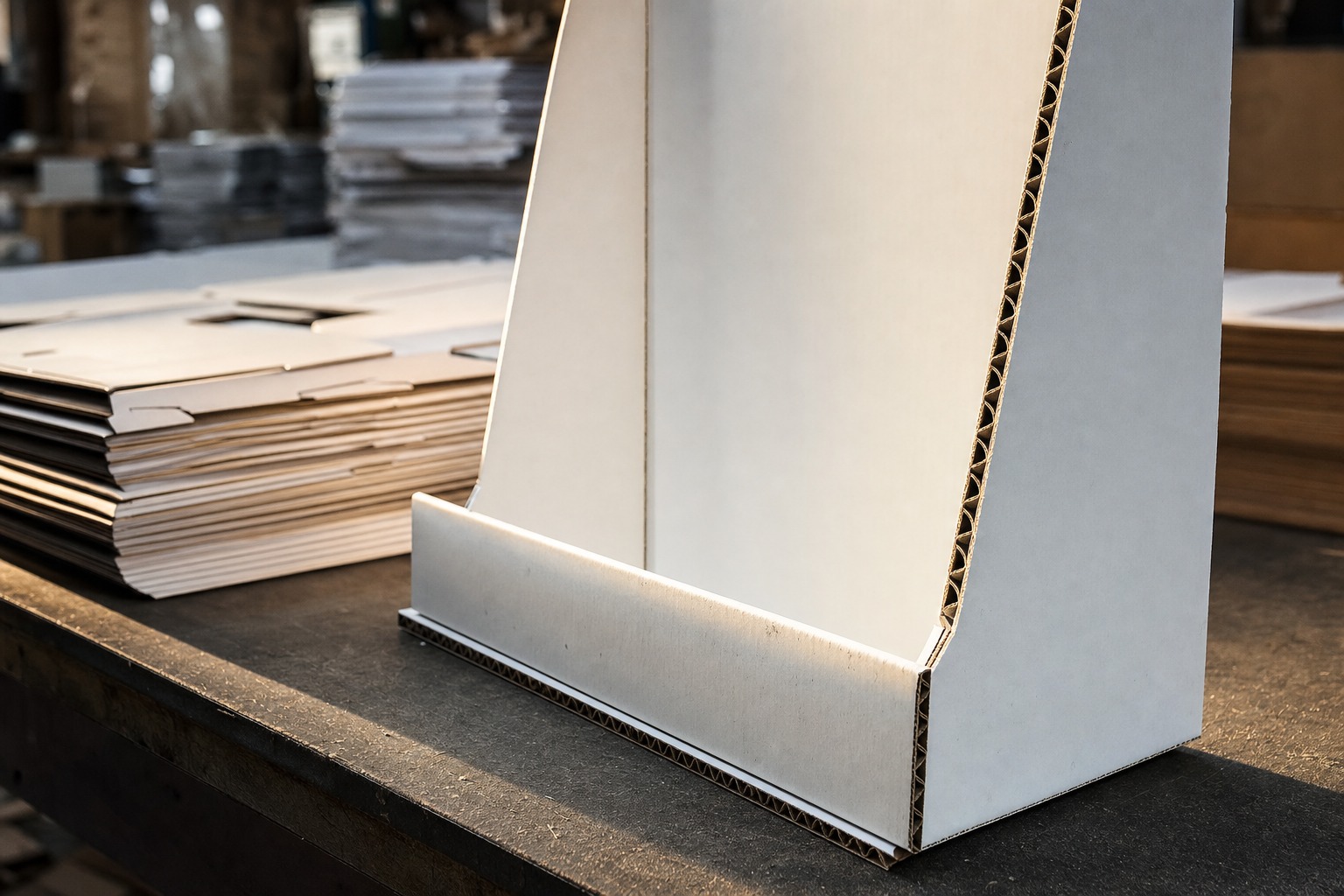
Corrugated board is widely used because it is printable, lightweight, die-cuttable and efficient to ship flat. Different flute profiles, corrugated cardboard combinations and reinforced components can be selected according to the display’s size and load.
For heavier merchandise, the designer may add features such as:
- Double-wall corrugated components
- Reinforced shelves or shelf lips
- Internal supports and dividers
- Load-bearing trays
- Plastic clips or metal brackets
- A separate base or pallet skirt
- Protective coatings in handling areas
Provide actual product samples whenever possible. Dimensions and stated weights are helpful, but physical samples reveal how packages stack, shift and interact with shelf openings.
Load capacity should be evaluated for the complete display, not only an individual shelf. Ask whether the supplier can create a structural prototype and test it using the intended product arrangement.
Plan graphics, printing and finishing together
POP graphics should be developed for the final structure, viewing distance and store environment. Printing decisions affect colour, durability, turnaround and the visual consistency of the broader retail campaign.
Offset printing is often considered for higher-volume programs and demanding colour reproduction. Digital printing is useful for samples, shorter runs, regional versions, test campaigns and variable graphics. The best method varies by quantity, display size, substrate and finishing requirements.
Finishing options can include:
- Gloss, matte or soft-touch lamination
- Protective aqueous or UV coatings
- Spot coatings for visual contrast
- Foil stamping or embossing
- Die-cut windows and dimensional elements
- Mounted headers, wings and shelf strips
- Hooks, clips and other display hardware
Design files should include a supplier-approved dieline. Keep logos, legal copy and other critical elements away from folds, slots, glue areas and hardware positions. Barcodes and QR codes should be tested at final size on the intended material and finish.
Accent Impression designs, prints, finishes, kits and manages fulfillment for POP and POS displays used in multi-store retail rollouts across Canada, using its own production capabilities in Montreal.
Include production sampling and store setup in the buying decision
A production-ready sample confirms fit, strength, graphics and assembly before the complete order is manufactured. It is one of the most important approval stages for custom POP displays.
A blank structural sample is useful for checking dimensions, product fit and load distribution. A digitally printed version also allows the buyer to review graphic placement, messaging and the shopper-facing presentation.
The approval process should cover:
- Overall footprint and height
- Number of products or facings
- Loaded shelf performance
- Product replenishment
- Stability during shopper interaction
- Header and side-panel visibility
- Assembly time and required tools
- Pack-out and shipping protection
- Disposal or recycling instructions
Store employees may have only a few minutes to assemble each unit. Ask for clear instructions with numbered steps and diagrams. If setup is complicated, consider pre-assembled or partially assembled displays, subject to shipping costs and available space.
Match the display to the retail use case
The strongest point of purchase display is designed for a specific merchandising task rather than treated as a generic sign holder. Its structure, messaging and pack-out should support how the retailer will receive, position and replenish it.
Product launches
Launch displays often require strong brand visibility, educational messaging and space for multiple variants. A modular structure can help stores maintain a presentable retail display as inventory sells through.
Seasonal promotions
Holiday and seasonal programs are schedule-sensitive. Confirm retailer delivery windows, store quantities and language versions early, especially when distribution extends across Quebec and the rest of Canada.
Sampling and demonstrations
Displays for demonstrations may need counters, storage, waste openings or replaceable graphic panels. The design should consider staff movement, food-contact restrictions where applicable and repeated cleaning.
For campaigns involving regulated, health-related or food products, buyers may also need to review a supplier’s certifications and determine whether they are relevant to the project. Pubco holds a GMP certification from Health Canada under site licence number 302640, HACCP compliance certification from 2022 and Forest Stewardship Council certification number C210792. These credentials do not replace confirmation of the requirements for a particular product, retailer or direct food-contact application.
Multi-store rollouts
National and regional rollouts require more than printing. Units may need to be collated with products, instructions, shelf signage, decals and promotional items, then labelled and shipped by store.
This is where kitting and fulfillment become critical. A supplier should be able to work from a store allocation file, accommodate different kit configurations and provide shipment tracking or distribution records.
Compare Montreal POP display suppliers on complete program capability
Compare suppliers by examining structural expertise, print control, finishing, kitting and delivery, not simply the unit price. The least expensive display can become costly if it fails under load, arrives late, does not meet retail compliance requirements or requires excessive labour in stores.
A search for providers should distinguish companies offering only design from those providing actual production, a distinction reflected in Montreal-area display design and production categories.
Ask each prospective supplier:
- Is structural design completed in-house?
- Which parts of printing and finishing are produced internally?
- Can the supplier create a loaded prototype?
- How is colour approved and controlled?
- Will displays ship flat, assembled or packed with products?
- Can store-specific kits and labels be produced?
- Is bilingual English and French versioning supported?
- Can one program include displays, window graphics, shelf materials and packaging?
- Who is responsible if separate components do not fit together?
- How are replacements and store shortages handled?
Quotes should use the same specifications. Clearly state quantities, sizes, materials, number of versions, print coverage, finishing, assembly, pack-out and delivery destinations. Tooling, samples, freight and distribution services may appear as separate charges, so compare total program cost rather than only the display price.
Frequently asked questions about custom POP displays
Custom POP display projects usually raise questions about quantities, timing, materials and retailer approval. Answers vary by structure and campaign, but the following points help buyers prepare an accurate brief.
What information is needed to quote a custom POP display?
Provide the display type, target dimensions, quantity, campaign duration, product dimensions and weights, number of SKUs, print requirements, finishing, preferred shipping format and delivery locations. Include retailer specifications and product samples when available.
How long does it take to make a custom POP display?
Turnaround varies by job. Structural design, retailer approval, printing, die-cutting, assembly and distribution all affect the schedule. Complex multi-store programs should allow time for a physical prototype and revisions before production.
Can POP displays be shipped flat?
Many corrugated displays can be engineered to ship flat, reducing storage and freight volume. Flat-packed units must still be easy for store teams to identify and assemble, with all components and instructions included.
What is the best material for a temporary retail display?
Corrugated cardboard is often suitable because it combines printability, low weight and structural flexibility. The correct board grade and reinforcement depend on product load, footprint, campaign length and expected handling.
Should a POP display be tested with real products?
Yes. Testing with the intended products helps confirm shelf strength, stability, capacity, accessibility and replenishment. It can also identify packages that slide, lean or obscure important graphics.
Can one supplier manage displays and the related retail print?
Yes, if the supplier offers coordinated commercial printing, finishing and distribution services. Consolidating displays, shelf talkers, window signage, floor decals, product labels and store kits can improve colour consistency and simplify delivery.
Request a quote
Have a print or packaging project? Talk to our team. We take it from concept to delivery, on our own presses, here in Montreal.